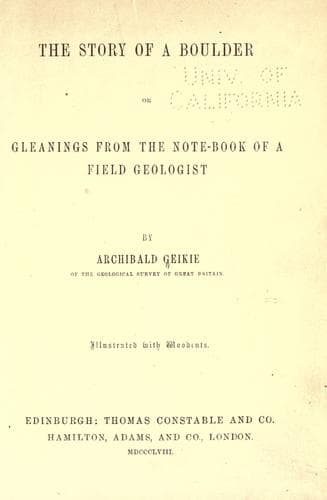
The Story of a Boulder; or, Gleanings from the Note-book of a Field GeologistGeikie, Archibald
Science
The Story of a Boulder; or, Gleanings from the Note-book of a Field Geologist
Geikie, Archibald
Geology; Petrology
has been stranded on such shores as those of the higher parts of the
Firth of Forth. These Burdiehouse ichthyodorulites give positive proof
that the limestone could not have originated in a lake, and the only
explanation left is that of a river-bottom.
But it may perhaps be objected that, after all, these fish-remains
are for the most part fragmentary, and may consequently be drifted
specimens, so that no conclusion as to the source of the rock can be
based on their occurrence there. The imbedded land-plants confessedly
came from some distance, why may not the same have been the case with
the bones and scales of the river-haunting ganoid fishes? And, indeed,
did we regard these fish-bones and scales merely in themselves, the
argument might not perhaps be very easily answered, although the great
numbers and perfect outline of the bones, teeth, and scales, afford
pretty strong evidence that the owners lived and died in the locality
where their remains are found. But there is a curious kind of evidence
to be gleaned from the rocks around them whereby this objection can be
at once set aside. In the limestone itself, and especially in some of
the shales above, there occur vast numbers of small oblong coprolitic
concretions of a dirty yellow or brown colour, full of scales and
fragments of bone. There can be no doubt that these are the excremental
remains of predaceous animals, while their great number and perfect
preservation assure us that they could not have been drifted from a
distance, but must rather have been deposited on the spot where we now
find them. And thus we conclude that the site of Burdiehouse must have
been a favourite haunt of these bone-covered fishes; that the bulkier
forms, armed with pointed teeth or barbed-spines, preyed upon their
humbler congeners, while these in turn may have fed on the cyprides
that swarmed by millions at the bottom of the estuary. I have often
detected in these coprolites the peculiarly-sculptured scales of the
palæoniscus. These graceful little animals must, therefore, have died
that their lordlier brethren might dine.
On a survey, then, of the whole evidence from fossils, we are led to
conclude that the Burdiehouse limestone was slowly elaborated at the
bottom of an estuary, into which the remains of terrestrial plants were
drifted from the land, while bone-covered fishes haunted the waters,
and into these busy scenes huge sharks ascended from the sea to share
in the decaying putrescent matter ever brought down from the interior.
Public-domain text, read in full here on John Shaqi.
Reviews
Reviews
No reviews yet
Be the first to share your thoughts on this work.
Elsewhere in the archive
Join the Discussion
Join the discussion
Sign in to leave a comment or review.
Sign InorCreate an account