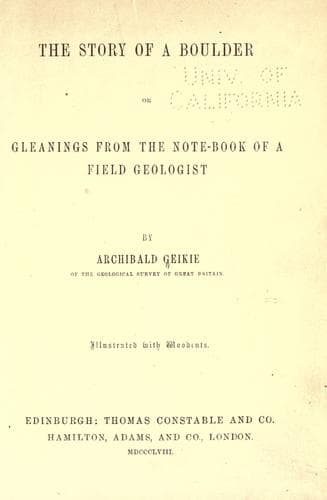
The Story of a Boulder; or, Gleanings from the Note-book of a Field GeologistGeikie, Archibald
Science
The Story of a Boulder; or, Gleanings from the Note-book of a Field Geologist
Geikie, Archibald
Geology; Petrology
At last, however, this condition of things came to be modified. The
direction of the river channel along some part of its course had
varied, or some analogous change had taken place, so that muddy
sediment transported from the land sank down amid the cyprides at
the bottom. In circumstances so uncongenial these tiny denizens
of the estuary diminished in numbers until the silt and sand came
down so rapidly and in such abundance that they eventually died out.
Alluvial matter still darkened the water and covered the river-bottom,
enveloping now the fronds of a delicate fern that had waved along
the margin of some sequestered lake far inland, anon a seed-cone
that had been shaken by the breeze from the spiky branches of some
tall club-moss. Among these muddy beds occur numerous coprolites and
fish-scales, along with cypriscases and a few shells of unio (?),
showing that though the cyprides were decreasing, the water still
presented the old estuary conditions and still swarmed with life.
Eventually there came other changes in the direction or rapidity of
river currents, and the accumulations of mud and silt were succeeded by
a long protracted deposition of yellow sand, now forming the sandstone
of Straiton. It enclosed many stems of stigmaria, lepidodendron, &c.,
and in certain limited areas these plants matted together in such
quantities that their remains now form thin irregular seams of coal.
It would appear, therefore, that notwithstanding these changes in the
matter transported and deposited at the locality in question, the
estuary character of the locality remained essentially the same. The
sand was at length replaced by fresh accumulations of mud and sandy
silt, which went to form the beds of shale and shaly sandstone now
found above the Straiton rock.
When in the course of many long centuries a depth of strata amounting
to fully 300 feet had been amassed, the area of Mid-Lothian underwent
a total change. Owing to a depression of the earth's crust, that seems
to have been general over the whole of central Scotland, the estuary
in which the Burdiehouse limestone and superincumbent strata were
deposited became open sea. As the evidence of this change rests solely
on the character of the imbedded organic remains, we shall pursue our
induction by examining the beds somewhat in detail.
Public-domain text, read in full here on John Shaqi.
Reviews
Reviews
No reviews yet
Be the first to share your thoughts on this work.
Elsewhere in the archive
Join the Discussion
Join the discussion
Sign in to leave a comment or review.
Sign InorCreate an account