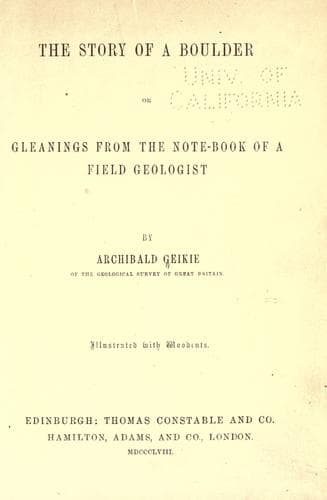
The Story of a Boulder; or, Gleanings from the Note-book of a Field GeologistGeikie, Archibald
Science
The Story of a Boulder; or, Gleanings from the Note-book of a Field Geologist
Geikie, Archibald
Geology; Petrology
great stream is reached, gushing from the splintered sides of some
lone rock, or pouring perchance out of the glimmering caverns of some
massive glacier high amid the regions of perpetual snow.
Many attempts have been made to estimate the amount of time which
some of our coal-fields may have required for their accumulation.
But so large a number of conjectural elements must necessarily enter
into such calculations, that the results come to be of very doubtful
value. By estimating the amount of sediment annually transported by
such rivers as the Ganges or Mississippi, we may ascertain how long a
mass of similar sedimentary strata would take to form under similar
conditions. And if our calculation had to do merely with such detrital
accumulations, we might hope to arrive at some approach to accuracy.
But besides these sedimentary strata, the formation of which must have
been wholly analogous to that of similar deposits at the present day,
we have to deal with the problems suggested by the coal-seams. We know
nothing of the climate of the Carboniferous period save what may be
conjectured from the analogy of existing climates; and in a question
regarding the accumulation of decaying vegetable matter climate is a
subject of the first importance. We are ignorant, too, of the rate of
growth peculiar to the carboniferous flora; and even if we hold that
it was probably rapid, the process of decay may have been equally
speedy, and so a forest might go on shooting up fresh trees as the old
ones rotted away, yet at the end of a thousand years there might be a
scarcely greater thickness of vegetable matter on the ground than at
the commencement. A seam of coal two feet thick might thus represent,
say the accumulation of a hundred years, and another of exactly the
same thickness might stand as the accumulation of a thousand years.
Until we know more of the vegetation and climate of the coal period,
the thickness of a coal-seam can hardly be held as a certain guide to
the lapse of time required for its formation.
For the sake of illustration, let me take the following fragment of a
coal-measure section:--
Shale, 20 feet.
Coal, 4 "
Fire-clay, 6 "
Sandstone, 40 "
Public-domain text, read in full here on John Shaqi.
Reviews
Reviews
No reviews yet
Be the first to share your thoughts on this work.
Elsewhere in the archive
Join the Discussion
Join the discussion
Sign in to leave a comment or review.
Sign InorCreate an account