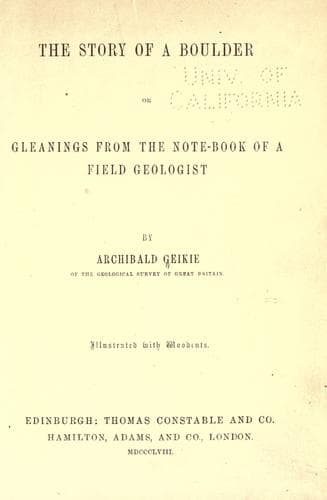
The Story of a Boulder; or, Gleanings from the Note-book of a Field GeologistGeikie, Archibald
Science
The Story of a Boulder; or, Gleanings from the Note-book of a Field Geologist
Geikie, Archibald
Geology; Petrology
Trap-rocks generally may be variously classified according to the
aspect under which we view them. Mineralogically they are _augitic_,
when the mineral _augite_ enters largely into their composition;
_hornblendic_, when the _augite_ is replaced by _hornblende_; and
_felspathic_, where _felspar_ forms the most marked constituent.
The first class includes all the dark homogeneous compounds called
_basalts_; the second, the hornblendic _greenstones_, or _diorites_;
and the third, the _felstones_, _porphyries_, and _tufas_.
Geologically, they are _beds_ when they are interstratified with the
contiguous rocks; and _dykes_ or _veins_ when they penetrate them like
walls, or in an irregular manner. The former class may be either of
the same age with the rocks among which they lie, or of a later date,
just as in a pile of books the centre one may either have been placed
there originally with the rest, or thrust in long afterwards. The
latter class must always be later than the rocks which they traverse,
for it is plain the rocks must have been in existence before trap-dykes
and veins could be shot through them. Hence geologists are accustomed
to speak of contemporaneous and subsequent trap-rocks: the one list
including all the tufas, and those melted rocks which can be shown to
have been erupted during the time when the limestones, sandstones, or
shales around them were forming; the other embracing all the dykes and
veins along with those beds of melted rock which have been intruded
between the strata. These and other distinctions will be better
understood from a few examples collected chiefly from the carboniferous
district of central Scotland.
Public-domain text, read in full here on John Shaqi.
Reviews
Reviews
No reviews yet
Be the first to share your thoughts on this work.
Elsewhere in the archive
Join the Discussion
Join the discussion
Sign in to leave a comment or review.
Sign InorCreate an account