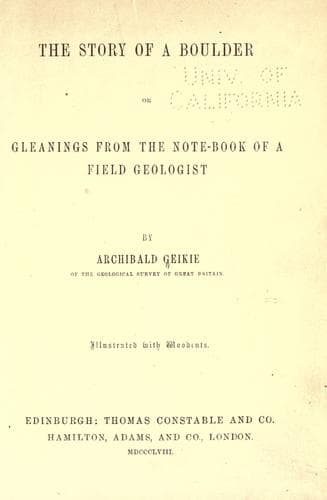
The Story of a Boulder; or, Gleanings from the Note-book of a Field GeologistGeikie, Archibald
Science
The Story of a Boulder; or, Gleanings from the Note-book of a Field Geologist
Geikie, Archibald
Geology; Petrology
as widely as in any other stratified rock, being sometimes land-plants,
sometimes sea-shells.
Such are some of the more obvious characters of the volcanic ashes or
tufas, as developed among the carboniferous rocks of central Scotland.
Their great varieties of composition and general aspect render them
a somewhat difficult set of rocks to master, but when fairly and
fully understood they soon prove themselves to be by far the most
interesting section of the traps, for one needs seldom to hesitate a
moment as to their origin or date, while their fossil contents impart
to them an interest all their own. By comparing such rocks with the
consolidated ash or fine dust and _lapilli_ of a modern volcano, a
remarkable resemblance of external characters is found to subsist; and
this likeness holds sufficiently close, when pursued into details, to
show that the ancient and the modern rocks have resulted from the same
source, that, namely, of volcanic eruption. The ash of active burning
mountains falls down their sides loosely and incoherently, every
successive shower of dust or scoriæ settling without much regularity
on those that have gone before. The ash of the old carboniferous
eruptions, however, was showered for the most part over the sea or
across wide shoaling estuaries, at least it is only such portions of
it as fell there that have come down to our day. Settling down among
the mud and sand at the bottom, the volcanic matter accumulated in
wide horizontal beds, every marked inequality being smoothed down by
the currents until a series of regularly stratified layers came to be
formed, entombing any organisms that might find their way to the bottom
or be lying there at the time. The ash of terrestrial volcanoes has no
marked stratification because thrown out in open air, while that of
the carboniferous rocks of central Scotland is distinctly bedded from
having been deposited under water.
Public-domain text, read in full here on John Shaqi.
Reviews
Reviews
No reviews yet
Be the first to share your thoughts on this work.
Elsewhere in the archive
Join the Discussion
Join the discussion
Sign in to leave a comment or review.
Sign InorCreate an account