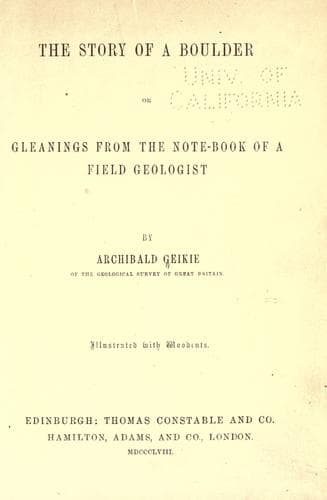
The Story of a Boulder; or, Gleanings from the Note-book of a Field GeologistGeikie, Archibald
Science
The Story of a Boulder; or, Gleanings from the Note-book of a Field Geologist
Geikie, Archibald
Geology; Petrology
still seen imbedded in the fire-clay on which, as a soft muddy soil,
they originally grew. It is probable, however, that, notwithstanding
such elevations of the sea-bed, there was a general subsidence of the
ground during the accumulation of these strata, for we see that the
peaty morass, represented now by the coal-seam, ere long sank beneath
the waters, with the inroads of which it was unable to keep pace, while
there slowly silted over it a muddy sediment that hardened at length
into what is now a seam of shale. But this order of things had been in
existence for but a comparatively short period when the igneous forces
broke out again, ejecting a stream, of molten lava that spread along
the bottom of the shallow waters and hardened as before into a sheet
of greenstone. This was followed by an abundant shower of dust and
lapilli, along with numerous large masses of greenstone and basalt.
These falling into the water accumulated on the upper surface of the
lava-stream, then somewhat cooled, and formed in the end a stratum of
ash of a rubbly conglomeritic aspect. That the sheet of greenstone
really spread out along the sea-bottom before the ejection of the ash,
and was not intruded among the beds at a later period,--that, in short,
it must be regarded as a contemporaneous and not as an intrusive rock,
seems sufficiently shown by its great regularity and evenness, and by
the unaltered condition of the fine soft felspathic matter which covers
its upper surface. It was assuredly in a highly-heated condition when
poured out, as may be gathered from the baked aspect of the mud over
which it rolled; but it had cooled and solidified, at least along its
upper surface, ere buried beneath the shower of ashes. The last bed
exhibited in the section is a grey sandstone, with many carbonaceous
streaks and traces of land-plants, showing a pause in the volcanic
activity of the district, during which the streams from the land
brought down sandy sediment, with an abundant admixture of macerated
leaves, branches, and other drift-wood.
It thus appears that not only were the plains and hills of the
Carboniferous era richly clothed with vegetation, and its waters
crowded with animals, but that then, as now, subterranean forces were
at work, sometimes elevating, sometimes depressing the area alike of
the land and of the sea; while, not unfrequently, melted lava rose
from below, rolling along the bottom of the waters, and showers of
ashes were flung far and wide through the air, settling at last as a
thickening sediment along the floor of the sea, or athwart the marshy
swamps of the delta. Whether the interior of the land had burning cones
among its pine-covered hills we know not yet. Such, however, probably
existed; nay, there may have been among the higher peaks some "snowy
pillar of heaven," like the Ætna of Pindar, raising its smoking summit
among everlasting crags of ice in solitudes lifeless and bare.[77]
Public-domain text, read in full here on John Shaqi.
Reviews
Reviews
No reviews yet
Be the first to share your thoughts on this work.
Elsewhere in the archive
Join the Discussion
Join the discussion
Sign in to leave a comment or review.
Sign InorCreate an account