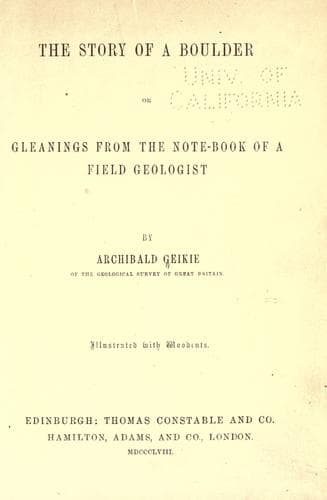
The Story of a Boulder; or, Gleanings from the Note-book of a Field GeologistGeikie, Archibald
Science
The Story of a Boulder; or, Gleanings from the Note-book of a Field Geologist
Geikie, Archibald
Geology; Petrology
The Crustacea, so called from the hard crust or shell which envelops
them, form, with all their orders and genera, a very numerous family.
They are of interest to us as containing among their number some of
the oldest forms of life. Away down in the lower Silurian rocks, among
the most ancient fossiliferous strata, we find the crustacean with
its armour of plates and its prominent sessile eyes set round with
lenses, still visible on the stone. Thus, on the first page of the
stony records of our planet's history are these primeval organisms
engraved. In some localities, where oxide of iron is largely present,
they are coated with a bright yellow efflorescence, and stand out
from the dull grey stone like figures embossed in gold.[31] On all
the subsequent leaves of this ancient chronicle, we can detect the
remains of crustacean life, and many tribes still swarm in our seas
and lakes. It is interesting, however, as marking the onward progress
of creation, to notice that, though this great family has continued
to live during all the successive geological ages, its members have
ever been changing, the older types waning and dying out, while newer
genera rose to supply for a time their place, and then passed away
before the advance of other and yet later forms. The trilobites that
meet us on the very verge of creation, swarmed by millions in the seas
of the Silurian ages, diminished gradually during the era of the Old
Red Sandstone, and seem to have died out altogether in the times of
the Coal. In no ocean of the present day is a trace of any of their
many genera to be seen. The _decapods_, of which our common crab is a
typical form, began to be after the trilobites had died out. In all the
subsequent eras they gradually increased in numbers, and at the present
day they form the most abundant order of crustacean life. The history
of these two divisions, to adopt Agassiz's mode of representation, may
be illustrated by two long tapering bands like two attenuated pyramids.
The one has its broad base resting upon the existing now, and thinning
away into the past, till at last it comes to a point. At a little
interval the apex of the other begins, and gradually swells outward as
it recedes, till the wide base terminates at the first beginnings of
life.
[Footnote 31: Such is the aspect of the organisms in some of the
Silurian sandstones near Girvan. I have seen the same bright tint
on a set of fossils from the Llandeilo flags of Wales, and from the
slates of Desertcreat, Ireland, and have disinterred similarly gilded
shells from the vertical greywackè slates of the Pentland Hills and
Peeblesshire. Nothing can be more beautiful than the aspect of these
fossils when first laid open, but the bright gleam eventually passes
away on exposure.]
Public-domain text, read in full here on John Shaqi.
Reviews
Reviews
No reviews yet
Be the first to share your thoughts on this work.
Elsewhere in the archive
Join the Discussion
Join the discussion
Sign in to leave a comment or review.
Sign InorCreate an account