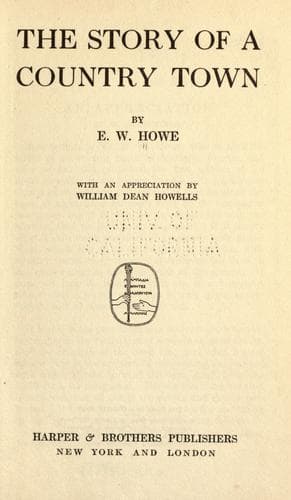
The Story of a Country TownHowe, E. W. (Edgar Watson)
General
The Story of a Country Town
Howe, E. W. (Edgar Watson)
Frontier and pioneer life -- Kansas -- Fiction
When we went to supper at the hotel the same men were there, and, as I
expected, Bragg was in better humor, promising by dark to be agreeable.
His principal characteristic was sullen indifference, and I wondered if
a bomb exploded under his chair would disturb him. They all disliked
him, evidently, from which circumstance I imagined he regarded them as a
herd, as he had regarded the people of Fairview. Nobody spoke to him or
he to any one, and his only tribute to the approaching darkness was a
noticeable softening in his indifference, for occasionally he stopped
his jaws--he munched his food like an animal, and impatiently, as though
he disliked the disagreeable necessity of having a habit in common with
such people--to listen to what was being said; but at dinner he was
oblivious to everything. He went out before me, and when I passed
through the office I saw him looking at a copy of the “Union of States,”
and I was glad we had not yet taken charge, for I was sure he was making
fun of it.
After Martin came out we walked down to the house where we were to live,
which was a considerable distance down the street from where the hotel
was kept, and which was in a lonely location on the brow of a hill
overlooking the valley and the mills. Directly opposite, and across the
river, were the mounds which gave the town its name, a pair of little
mountains where it was said the Indians built signal fires when they
occupied the country, and where they buried their dead, for human bones
were often found there by curious persons who dug among the rocks. The
house was built of stone, in the centre of a great many lots, surrounded
by heavy hardwood trees, and as we went through the rooms Martin
explained that it had been occupied long before he came there by an
Indian agent, and that Twin Mounds was originally an agency, where the
Indians came to draw their supplies. But the agency and the Indians had
been removed further west years ago, and the house sold to an eccentric
bachelor, who occupied it alone until a few months before, when he died,
and the place being offered for sale, it came into possession of my
father. It was two stories high, built in such a manner as to contain
six large rooms of about the same size, and there were iron shutters at
all the windows and doors, and the roof was of slate, which Martin said
was a precaution the agent had taken against the treachery of his wards.
It was in good repair, but I feared we should be very lonely in it, and
felt better when we were out in the street again.
Public-domain text, read in full here on John Shaqi.
Reviews
Reviews
No reviews yet
Be the first to share your thoughts on this work.
Elsewhere in the archive
Join the Discussion
Join the discussion
Sign in to leave a comment or review.
Sign InorCreate an account