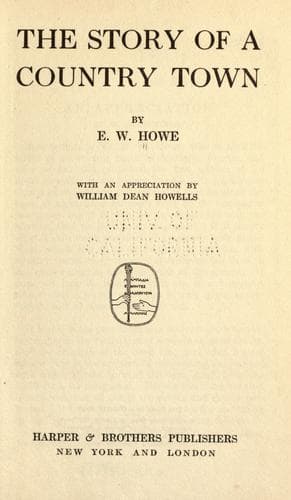
The Story of a Country TownHowe, E. W. (Edgar Watson)
General
The Story of a Country Town
Howe, E. W. (Edgar Watson)
Frontier and pioneer life -- Kansas -- Fiction
There was the usual number of merchants, professional men, mechanics,
etc., who got along well enough, but I never knew how at least one half
the inhabitants lived. Some of them owned teams, and farmed in the
immediate vicinity; others “hauled,” and others did whatever offered,
but they were all poor, and were constantly changing from one house to
another. These men usually had great families of boys, who grew up in
the same indifferent fashion, and drifted off in time nobody knew where,
coming back occasionally, after a long absence, well-dressed, and with
money to rattle in their pockets. But none of them ever came back who
had business of sufficient importance elsewhere to call them away again,
for they usually remained until their good clothes wore out, the
delusion of their respectability was broken, and they became town
loafers again, or engaged in the hard pursuits of their fathers. The
only resident of Twin Mounds who ever distinguished himself ran away
with a circus and never came back, for although he was never heard of it
was generally believed that he must have become famous in some way to
induce him to forego the pleasure of returning home in good clothes, and
swaggering up and down the street to allow the people to shake his hand.
This class of men never paid their debts, and to get credit for an
amount was equal to earning it, to their way of thinking, and a new
merchant who came in did a great business until he found them out. I
have said they never paid; they did sometimes, but if they paid a dollar
on account they bought three or four times that amount to go on the
books.
They always seemed to me to be boys yet, surprised at being their own
masters, and only worked when they had to, as boys do. They engaged in
boys’ amusements, too for most of them owned packs of dogs, and
short-distance racehorses, and it was one of their greatest
accomplishments to drive a quarter-horse to a wood-wagon to some
out-of-the-way neighborhood, match it against a farmer’s horse
threatened with speed, and come back with all the money owned in that
direction. I suppose they came West to grow up with the country, like
the rest of us, but they were idle where they came from, and did not
improve in the West, because work was necessary, whereupon the thought
no doubt occurred to them that they could have grown rich in that way
anywhere.
A few of them were away most of the time--I never knew where, but so far
away that they seldom came home--and their families supported themselves
as best they could, but were always expecting the husbands and fathers
to return and take them away to homes of luxury. Occasionally news came
that they were killed by Indians, and occasionally this was contradicted
by the certainty that they were locked up for disreputable transactions,
or hanged. Whenever a Twin Mounds man died away from home otherwise than
honorably, it was always said that he had been killed by the Indians.
Public-domain text, read in full here on John Shaqi.
Reviews
Reviews
No reviews yet
Be the first to share your thoughts on this work.
Elsewhere in the archive
Join the Discussion
Join the discussion
Sign in to leave a comment or review.
Sign InorCreate an account