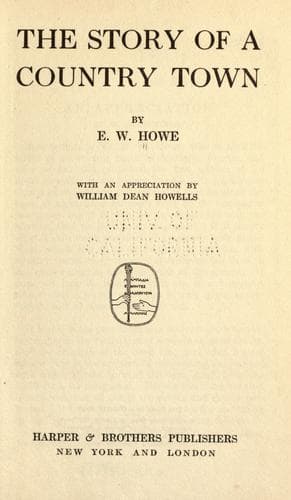
The Story of a Country TownHowe, E. W. (Edgar Watson)
General
The Story of a Country Town
Howe, E. W. (Edgar Watson)
Frontier and pioneer life -- Kansas -- Fiction
Bragg was educated, and when he talked to the town people at all it was
to point out their ignorance, which he did with a bitter tongue. If he
was seated in front of the usual loitering places on a summer evening,
which he sometimes did because there was nothing else to do, he made
everybody uncomfortable by intently watching for opportunity to
insolently point out mistakes, and if he ever read or studied at all it
was for this purpose. Occasionally there came to the town a traveller
who was his equal in information, who beat him in argument and
threatened to whip him for an insolent dog, which afforded the people
much satisfaction. I remember a commercial traveller who sold the
merchants nearly all their goods because he once threw a plate of soup
in Bragg’s face at the hotel table, and then, leading him out into the
yard by the ear, gave him a sound beating; but I do not remember what
the occasion of the difficulty between them was, though it was probably
no more than his ordinary impudence.
He had an office and apartments over a leather store a few doors above
the place where I worked, in front of which there was a porch, and he
sat out upon this, when the weather was pleasant, for hours at a time,
smoking cigars, and spitting spitefully into the street. The only man I
ever knew who visited his rooms was the leather dealer, who called on
Bragg once every three months to collect his rent. It was a part of the
town gossip that this man said the rooms were splendidly furnished, but
always darkened with rich and heavy curtains at the windows, and that it
was full of stuffed snakes, lizards, bats, and other hideous things;
that his match-safe was a human skull, and that a grinning skeleton hung
against the wall, which rattled and wildly swung its arms and legs every
time a draft or a visitor came in at the door. It was also related that
by means of ingenious strings he made the skeleton shake or nod its
head, and point with its arms, and I have imagined that when he was in
his apartments he employed himself in causing the figure to nod its head
in response to the assertion that Clinton Bragg was a fine fellow, or
shake it violently when asked if Clinton Bragg was a worthless dog, as
the people said.
Occasionally people who had lines to run knocked at his door in response
to the sign, “C. BRAGG, C. Engineer,” but even if he was at home he
would not let them in, for he had no intention of walking over the
prairie in the hot sun when he put out the sign. I never knew of his
doing anything in his line, although he might have been a great deal
employed, and finally no one applied there for admission except the
saddler for his rent, and a lame negro who swept and cleaned his
apartments, although it was quite generally believed that the Devil
called on him every bad night.
CHAPTER XVIII.
THE MILL AT ERRING’S FORD.
Public-domain text, read in full here on John Shaqi.
Reviews
Reviews
No reviews yet
Be the first to share your thoughts on this work.
Elsewhere in the archive
Join the Discussion
Join the discussion
Sign in to leave a comment or review.
Sign InorCreate an account