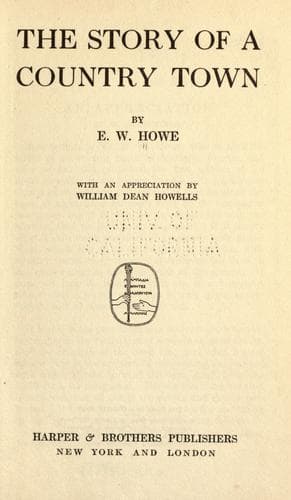
The Story of a Country TownHowe, E. W. (Edgar Watson)
General
The Story of a Country Town
Howe, E. W. (Edgar Watson)
Frontier and pioneer life -- Kansas -- Fiction
I do not remember who told me, but I learned from some source that
Mateel often complained of being lonely and of having nothing to do, and
I thought that this industrious man must soon overtake and pass her in
learning and ability, and that she would regret in her future that she
had not improved the opportunities of womanhood as he had improved the
opportunities of manhood. While Mateel was a pretty and amiable woman,
there was not the depth to her that Jo was acquiring, and I wondered if
it ever occurred to her that Jo would finally be a man worthy to be the
husband of any woman; a man self-reliant and self-taught, and expecting
a return for everything he gave. I wondered if she ever thought Jo had
been raised at a hard school, and would tire of simple amiability. If he
was anything at all, he was an example of what well-directed effort
would do, and I thought the day would come when he could not understand
why Mateel was not his equal, although she was older, and had every
opportunity, while he had none. I thought that as Jo had been friendless
all his life he would hope for a great deal of considerate affection
from his wife, and that he would be disappointed if he were compelled to
continue his old habit of being thoughtful of every one, but having to
regret that no one was thoughtful of him. I wondered if Mateel knew that
Jo was no longer the rough, awkward boy she had met during her first
week in Fairview, and that he was now a growing, vigorous man, ahead of
all his companions in ability and intelligence, and that every year he
would throw away old ideas for better ones. Jo had told her in his manly
love that she was a perfect woman, and that it would require his efforts
for a lifetime to become her equal, and I think she was pleased with
this, and believed it. I am certain she never said to Jo that he was a
remarkable fellow, and that he deserved more credit than she could give
him for his manly love for her--which was no more than the truth--but
rather thought herself worthy of the toil he had undergone; not that she
was selfish, perhaps, but because Jo had told her so, or maybe she had
never thought about it at all except that Jo was very fond of her, and
was anxious to please her. I would have given a great deal to know that
she frequently gave Jo a word of encouragement, but if she ever did he
never told me of it, and for this reason I was convinced that she never
did.
Public-domain text, read in full here on John Shaqi.
Reviews
Reviews
No reviews yet
Be the first to share your thoughts on this work.
Elsewhere in the archive
Join the Discussion
Join the discussion
Sign in to leave a comment or review.
Sign InorCreate an account