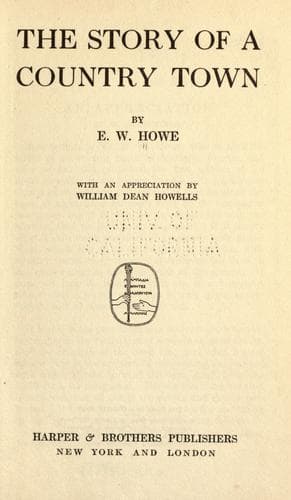
The Story of a Country TownHowe, E. W. (Edgar Watson)
General
The Story of a Country Town
Howe, E. W. (Edgar Watson)
Frontier and pioneer life -- Kansas -- Fiction
“Yes,” she replied, with her pretty laugh, “but you don’t seem to be the
same boy who came to school here a few years ago. You have grown so much
that you seem like a stranger instead of an old friend.”
She laughed merrily at my look of astonishment, and pretended to be
frightened when I went over and sat beside her.
“Why didn’t you say when you came in,” she asked, “‘This school is
dismissed; I am a friend of the teacher’s.’ I expected you to say that,
but instead you waited patiently until I should dismiss it myself. When
I knew Ned Westlock he was a boy of spirit. But I am as glad to see you
as I can be. This is my week at Theodore Meek’s, and you may drive me
there as slowly as your horses can walk.”
I am sure I felt like dismissing the school when I came in, but I never
thought of it. I never felt more at a loss in my life for something to
say, and sat looking at her in a sort of blind astonishment, blushing
like a child. I wanted to tell her how much pleasure the contemplation
of this visit had afforded me, but I could not; and finally, tiring of
being stared at, she got up and went to collecting the books and other
articles she intended to take home. I could think of nothing else to do,
so I went out and brought the buggy around to the door, and after
helping her in as awkwardly as I had stared at her, we drove away.
In my desperation I could only confess that I had been thinking for
weeks how polished and agreeable I would be in my manner on meeting her,
but that her pretty face and easy way had scared it all out of me; that
I came to Fairview expressly to see her, and that I hoped there would
never be a misunderstanding between us with reference to our friendship.
“There never will be,” she said, in her innocent and earnest way,
putting her arm through mine, and seeming reassured and pleased. “There
could be no misunderstanding between you and me, and there never has
been. Why should there be?”
She spoke as though I were still a boy, though I was now larger than she
was, and nearly sixteen. I felt sure she would always treat me as a boy,
no difference how old I became.
As we drove along slowly, I thought that if a stranger should see us he
would think we were lovers, but Agnes evidently did not think of it, for
she confessed her friendship for me in a hundred different ways, which I
am sure she would not have done had she thought of me as her lover. She
was in unusual spirits, and though I felt very proud to think that I was
the cause of it, I thought that the arrival of a pretty baby of which
she had once been fond would have made her as happy. I hinted gravely,
once or twice, that we were “growing older,” and that we “could not
always be children,” but she would only say that we were friends, and
enjoyed the friendship. I think she was content with that, and did not
look beyond it.
Public-domain text, read in full here on John Shaqi.
Reviews
Reviews
No reviews yet
Be the first to share your thoughts on this work.
Elsewhere in the archive
Join the Discussion
Join the discussion
Sign in to leave a comment or review.
Sign InorCreate an account