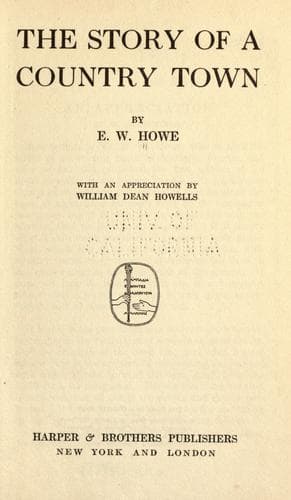
The Story of a Country TownHowe, E. W. (Edgar Watson)
General
The Story of a Country Town
Howe, E. W. (Edgar Watson)
Frontier and pioneer life -- Kansas -- Fiction
Her condition was so lonely that I became more of a son than I had ever
been before, and tried always to be careful of her wants. She
reciprocated this with kindness and attention, but I cannot say with
affection. When I went to my bed at night, I always left her sitting in
her chair, and after I had retired it was her custom to come softly up
the stairs to see if I was comfortable. If it was cold, she tucked the
covering about me as if I were yet a child, and I remember now--I do not
believe I thought of it then--that she talked to me more at these times
than at any other, as if the darkness removed a restraint. Perhaps she
felt a disgrace in the presence of her son that his parents had treated
him so indifferently, and only felt easy when he could not see her face.
Some men remember their mothers from their good-night kisses, but I
remember mine by the gentle manner in which she smoothed the covering of
my bed at night, and I grew so accustomed to it that I could not have
gone to sleep without it. After this was done, she lingered about the
room as long as she could find excuse, frequently referring to subjects
of which I had spoken in the evening, and then went slowly down the
stairs.
How she passed the night I never knew, but I never found her in bed.
Frequently I thought to go into her room at midnight, to see if she were
awake, but in waiting for the hour, I fell asleep. If I came home late
at night, whether she expected me or not, I found her up, and often when
a slight complaint made me wakeful and restless, I found her by my side,
offering me water, or some simple remedy. From the woman who came to the
house to work through the day, but who slept at home, I learned that my
mother frequently lay down in her room during the day, and probably
slept; so I think that generally she did not close her eyes at night nor
go to bed.
If I advised with her in reference to my father’s affairs--there was
really no need of it, for he left them in excellent shape, with full
instructions to me, and she knew nothing about them--she listened
attentively, but the details seemed to tire her. Occasionally a man
would intimate that my father had not credited a payment on an account
or a note, and appealing to her, she would say: “Your father was
honorable in business; the man is mistaken,” and so it turned out. If I
told her of my own affairs, she was equally attentive, but seemed to be
satisfied with my course, and had no suggestions to offer. I hoped to
hear her say I was doing well, or that the business did not miss its
founder, but if she thought it, she kept it to herself.
Public-domain text, read in full here on John Shaqi.
Reviews
Reviews
No reviews yet
Be the first to share your thoughts on this work.
Elsewhere in the archive
Join the Discussion
Join the discussion
Sign in to leave a comment or review.
Sign InorCreate an account