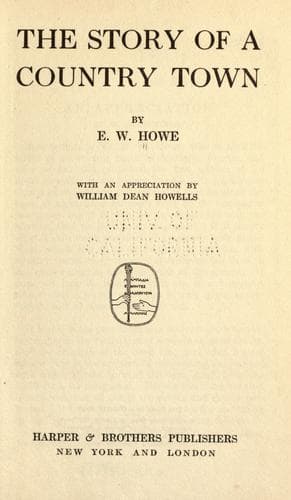
The Story of a Country TownHowe, E. W. (Edgar Watson)
General
The Story of a Country Town
Howe, E. W. (Edgar Watson)
Frontier and pioneer life -- Kansas -- Fiction
Jo and Mateel did not arrive until after dark, and we had the lights and
fires burning when they came in. After laying off her wraps Mateel
looked around the pleasant room, but did not say anything, seeming sick
and distressed, and when she went with us through the rooms, Agnes
carrying the light, she only said “Yes” when some one remarked that this
or that was pretty, or “No” when it was said that something else could
not be nicer. I thought that Jo was very much hurt at this, for she
seemed to take everything as a matter of course, and the only words she
spoke were as to what should have been done rather than as referring to
what had been done already, which was a great deal, for the house was
better furnished and more complete in every way than the one in which
she had lived. I thought at first that she was thinking the arrangements
for her comfort were no more than she deserved, if as much, but I
concluded later in the evening that she was not herself, and that the
parting with her mother had been a great trial, although I could not
understand why, for they were separated only by a few miles, and could
see each other every day.
We had been sitting about the fire for an hour or more, where we seemed
to get along better than at any other time during the day, when a rap
came at the door, and, on its being opened by Jo, Damon Barker walked
in. We were all very much delighted and surprised to see him, and after
saluting Jo and his wife with a polite word of congratulation, he took
the chair Agnes brought up, and sat down in the circle.
“I could not come over very well to-day,” he said, speaking to Mateel,
“so I came to-night. I thought I knew who would be here beside
yourselves,” looking at Agnes, and then at me, “and I find the company I
had expected. I wish you all a merry Christmas.”
We had not thought of it before, having been occupied with the events of
the day, but Barker suggested it by taking a number of packages from his
pockets, which he leaned against the legs of his chair. After we had
returned his compliment, he said:--
“I am not fond of ceremonies of any kind, but I am fond of a fire like
this on Christmas Eve, and a company like this, so I came unannounced. I
hope you are glad to see me.”
We all announced in a chorus that we were.
“It is very polite in you to say so,” Barker replied. “I lead a lonely
life over there,” pointing in the direction of his mill with the hand in
which he held another package from his pocket, looking very much like a
long bottle wrapped in brown paper, “though probably no lonelier than I
desire. Jo and I became very good friends when we were in solitude
together, and I think I could not have rested to-night had I not walked
over to congratulate him and his pretty bride.”
He settled down in his chair and looked around the room as if admiring
it.
Public-domain text, read in full here on John Shaqi.
Reviews
Reviews
No reviews yet
Be the first to share your thoughts on this work.
Elsewhere in the archive
Join the Discussion
Join the discussion
Sign in to leave a comment or review.
Sign InorCreate an account