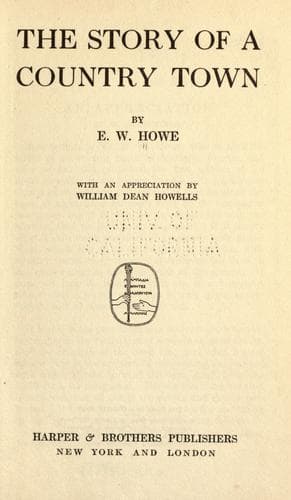
The Story of a Country TownHowe, E. W. (Edgar Watson)
General
The Story of a Country Town
Howe, E. W. (Edgar Watson)
Frontier and pioneer life -- Kansas -- Fiction
There was one thing I noticed of Twin Mounds which is probably true of
every other country town--it was constantly threatened either with great
prosperity or great danger, but whether the event threatening the
prosperity or the danger came to pass, the town progressed about the
same. There was no perceptible effect from any of the events the people
were certain would prove either very disastrous or of great benefit,
from which I am led to believe that no one is familiar with the art of
town-building, although I have never known a man who did not profess to
know all there is worth knowing about the science. Towns seem to be the
natural accretion of years, and although the people in Twin Mounds often
related how desperate were their struggles with adversity, the facts
probably are that the place would have been fully as large as it was
three years after Jo’s marriage without the great number of public
meetings for public purposes, and the endless worry of individuals with
reference to it.
There was a very general impression that manufactories were needed, and
this was talked about so much, and so many inducements were offered,
that the people became discouraged, believing that the average
manufacturer had a wicked heart and a hollow head to thus wrong Twin
Mounds in the face of his own interest, therefore we were very much
surprised to learn once, after all hope had been abandoned, that a
quiet man was building a woollen mill down the river, which he completed
and afterwards operated without the help of the committees which had
been appointed to aid in such matters of public weal. The trouble was
that the man lived in Twin Mounds, whereas we had been expecting a man
and money to come from a distant point for that purpose, and had never
thought of looking about home, but spent a great deal of money in
sending committees away to make arrangements for a woollen mill. This
circumstance, although humiliating, proved a good thing, for it taught
the people that, if the town were to be built up at all, it must be by
its own citizens, which knowledge was afterwards used to good advantage.
Public-domain text, read in full here on John Shaqi.
Reviews
Reviews
No reviews yet
Be the first to share your thoughts on this work.
Elsewhere in the archive
Join the Discussion
Join the discussion
Sign in to leave a comment or review.
Sign InorCreate an account