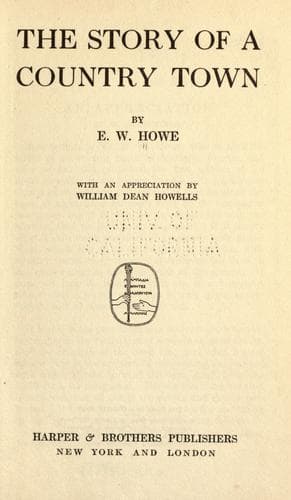
The Story of a Country TownHowe, E. W. (Edgar Watson)
General
The Story of a Country Town
Howe, E. W. (Edgar Watson)
Frontier and pioneer life -- Kansas -- Fiction
It was a popular expression that every one favorably mentioned was the
“worst overrated man in America,” and the only real ability any of them
ever displayed was in looking up the previous history of each other,
which they carried on with great vigor, and frequently with alarming
results. I began to believe in course of time that it was fortunate that
the discreditable part of my history was well known, for it was the
sooner forgotten, because it was not necessary to look up old records
to find it out, and thus was not made worse than it really was.
Very few of the Twin Mounds men had positive opinions of their own, as
they seemed to have got them second-handed from some source, and none of
them was original or natural in his methods of conducting business, or
in his habits. Two or three times a year most of them visited a city a
good many miles away, where they spent a great deal of money they could
not afford, to create an impression that they were accustomed to what
they supposed was good society, and where they met men who filled their
ideas of greatness. These they mimicked, each one choosing a different
example; so it happened that the men of Twin Mounds were very
ridiculous. There was a lawyer, I remember, who had met somewhere a
distinguished member of his profession, who shook hands (Ho! ho!) with
everybody, and (Ha! ha!) patronizingly wanted to know how they were
getting along. It was not his natural way, and as he only adopted it
because he believed it would make him popular, it became him very
poorly. Perhaps it was very effective with the man the habit had been
copied from, but it was very absurd with our citizen, whose pretence was
that every man he shook hands with (and he shook hands cordially with
everybody) was not getting along as well as he in his great compassion
desired.
Another one, who carried on a business which one busy day would have
exhausted, had heard of a man who achieved commercial greatness by
finding fault (I am sure the man was mistaken, for no one ever made
money in such a ridiculous way), and I never heard of anything that
suited him. This he regarded as business shrewdness, and he finally
became very sour in disposition because he was generally regarded as a
fool instead of a prophet. Still another, naturally full of fool’s gab,
carried on a bank in awful silence because he had heard that still water
runs deep, though I have seen ponds of perfectly still water which were
very shallow.
As I grew older, and began to notice more, I thought that every man in
Twin Mounds had reason to feel humiliated that he had not accomplished
more, but most of them were as conceited as though there was nothing
left in the world worthy of their attention. Their small business
affairs, their quarrels over the Bible, and an occasional term in the
town council, or a mention for the legislature or a county office,
satisfied them, and they were as content as men who really amounted to
something.
Public-domain text, read in full here on John Shaqi.
Reviews
Reviews
No reviews yet
Be the first to share your thoughts on this work.
Elsewhere in the archive
Join the Discussion
Join the discussion
Sign in to leave a comment or review.
Sign InorCreate an account