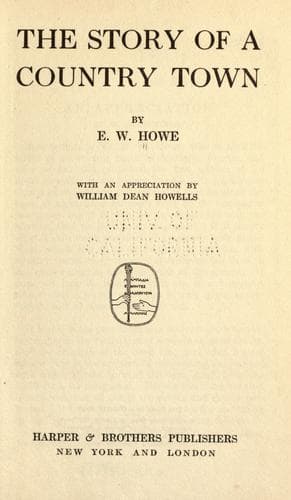
The Story of a Country TownHowe, E. W. (Edgar Watson)
General
The Story of a Country Town
Howe, E. W. (Edgar Watson)
Frontier and pioneer life -- Kansas -- Fiction
and other professional men is that I acknowledge that I am dishonest. My
position on the reform question is briefly this (and I may add that it
is the position of every man): I am against monopolies until I become a
monopolist myself. I am at present engaged in the reform business that I
may become a monopolist. If I should suddenly become rich, what would I
do? This: Refer to Alliances as dangerous, and such demagogues as myself
as suspicious loafers.”
Mr. Biggs seemed to greatly enjoy this denunciation of himself, and
ripped out an oath or two expressive of contempt for his victims.
“Our friend Bilderby, for example, who writes letters for your paper on
finance, and who professes to know all about money, in reality knows so
little about his subject that he cannot earn a living, although he seems
to be constantly worried with the fear that, from a mistaken financial
policy, the government will come to ruin. In fact, Bilderby only gets
time to write his letters on finance, and make excuses to his creditors.
The fellow owes the doctor for nearly all his children; I am certain he
has not paid for the younger ones. That is Bilderby’s way of being a
humbug; I have a different way; you have another, and there are so many
varieties, that every man is accommodated.”
Mr. Biggs was warming up, and unbuttoned his collar to talk with more
freedom.
“I see occasional notices in your publication to the effect that Chugg,
the groceryman, or whatever the name or the business may be, has just
returned from the East, which is extremely dull, and that he is
extremely glad to get back to the enterprising, the pushing, the
promising, the noble, and the beautiful West. That is YOUR way of being
a humbug, for in reality Chugg is glad to get back to the West because
he is of some importance here, and none there. The East is full of
hungry and ragged men who are superior in every way to the prominent
citizen of the name of Chugg, and Chugg knows it, therefore he is glad
to get back where he is looked upon as a superior creature. I have no
hesitancy in saying privately that the people in this direction are not
warranted in the belief that all the capable and energetic men have left
the East, though it would be disastrous to say as much publicly. When I
am in the East it occurs to me with great force that the miles of
splendid business buildings I see on every hand must be occupied by
talented and energetic men, and as we have no such buildings in the
West, it follows that we have no such men. When I see towering
manufactories--swarming with operatives who would be ornaments to the
best society out here--I think that at least a few men of energy and
capacity have been left to operate them, for ordinary men could not do
it. I ride down the long avenues of private palaces, each one of them
worth a township in the Smoky Hill country, and I am convinced that we
are mistaken in the opinion that a man must live on the frontier in
order to be energetic.”
Public-domain text, read in full here on John Shaqi.
Reviews
Reviews
No reviews yet
Be the first to share your thoughts on this work.
Elsewhere in the archive
Join the Discussion
Join the discussion
Sign in to leave a comment or review.
Sign InorCreate an account