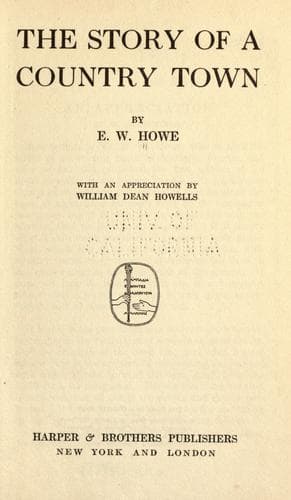
The Story of a Country TownHowe, E. W. (Edgar Watson)
General
The Story of a Country Town
Howe, E. W. (Edgar Watson)
Frontier and pioneer life -- Kansas -- Fiction
More than three years had passed since Jo and Mateel were married, and I
was alone on the last night of the year, thinking that the years were
slipping away wonderfully fast of late, it seemed so short a time since
we had lived in the country; since the Rev. John Westlock so strangely
disappeared, and since I was a boy in distress at my own and Jo’s
misfortunes. The good year was dying, and would soon pass peacefully
into the dim past, after the watchers had tired of waiting, and gone to
sleep. As is the case when an old man dies, the announcement is speedily
followed by the birth of a babe, and so the race and the years are
continued. As is now said of the dying year, so it will be said of all
of us. At some time in the mysterious future--nobody knows when--the
hand that writes this will be picking uneasily at the covering of a
death-bed, and it will be whispered in the room, and in all the house,
and down the streets, “He is dying; poor fellow, he is dead.” The eye
that reads this--at some time in the future; nobody knows when--will
become fixed, and it will be gently said “Dying; dead.” The front door
will be black with crape for a few days, and the people will pass the
house reverently and silently, but after a very little while the token
of death will be removed, the house will be thrown open and aired, and
laughter will be heard on the inside. Birds will sing merrily at the
front door, and flowers appear, and happy children play about the
house, and through it, as though nothing had happened. The dead man may
have been dearly loved, but everything and everybody encourages his
friends to forget him, and they laugh in the room where he died, and
where his coffin sat through the long nights before the burial.
The relics of departed friends, which were at first carefully laid away,
are in the course of months or years resurrected, and given to their
successors. The hat worn by the pretty boy who died last year, or the
year before, is worn to-day by the boy who came after him, and he plays
with his toys, which were at first so sacred, as though they had been
brought to the house for him. The mother who put the little hat away no
doubt thought she would keep it for years, and look at it to imagine
that her first-born was wearing it again, but time has softened her
grief; friends told her he was better off, and she hoped so, and tried
to convince herself that it was all for the best.
So it will be with the dying year; it was well loved while it lasted,
and brought us many good gifts, but it will be speedily forgotten, and
in twelve months we shall be equally indifferent as to its successor.
One dies; another is born; so go the people and the years. There will be
a birth and a death to-night, but it is not an uncommon circumstance:
there will be a little mourning for the death, but a great deal of
rejoicing and ringing of bells for the birth.
Public-domain text, read in full here on John Shaqi.
Reviews
Reviews
No reviews yet
Be the first to share your thoughts on this work.
Elsewhere in the archive
Join the Discussion
Join the discussion
Sign in to leave a comment or review.
Sign InorCreate an account