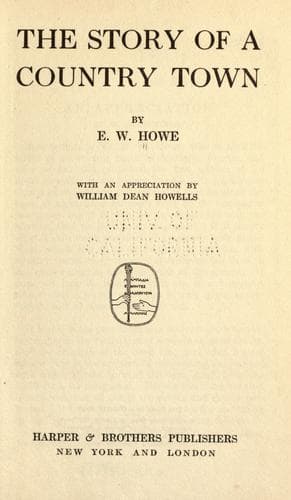
The Story of a Country TownHowe, E. W. (Edgar Watson)
General
The Story of a Country Town
Howe, E. W. (Edgar Watson)
Frontier and pioneer life -- Kansas -- Fiction
I did not know what to say in reply, for I could think of nothing that
would comfort him; and though I knew he would never again need my
friendship as he needed it then, this knowledge only confused me, and
made me stammer when I attempted to put in a word. He seemed to have so
thoroughly considered the matter that there was no defence, and stated
it so candidly that I thought he only expected me to pity him.
“Jo,” I said, as the thought occurred to me, “you undoubtedly received
this letter from Bragg; no one else would be malicious enough to send
it. Are you certain he did not write it?”
A new hope sprang into his eyes, though I noticed that his hand paused
on its way to the pocket which contained the letter, as though it was of
no use to look. But he unfolded the letter with trembling hands, and
studied it with great care, spending so much time over it that I hoped
we should have occasion to go out and find the scoundrel, and beat him,
but after Jo had finished his inspection, I saw that he was satisfied
that the letter was written by Mateel.
“That it might be a forgery never occurred to me before,” he said, with
a long sigh, “but it is genuine; there is no doubt.”
“I need not tell you, my dear old friend,” I said, “that I am sorry this
has happened. I regret it so much that I am powerless to comfort you, if
that were possible. Your tears have unmanned me.”
“I want to apologize to-night for my future,” he said, after a long
silence, “for I no longer have ambition. I can never succeed now, and I
want you to know why. If I do not advance in the future, I desire that
my only friend know that I no longer care to advance; that I have no
reason to wish for success, and that I am not trying. If I become a
Fairview man, miserable and silent, without hope or ambition, I want you
to know that I am not to blame. I have just such a business, and just
such a home, as we pictured together when we were boys. I have proved
to you that I did not over-estimate my strength, and if I do not
progress now that I am a man, you will know that my strength has been
broken. The home I built with so much care is distasteful to me; the
business I own after such a struggle, I hate; and I want you to know
that, while I have not tired of working, I no longer care to succeed.
The one above all others who should have helped me has only brought me
disgrace, and broken my heart. There was no contract between us, but
when Mateel became my promised wife, I made a vow to accomplish what I
have; I have succeeded, but she has succeeded in nothing except to bring
me this letter and its humiliating contents. I would not be a successful
man in the future if I could. Bragg will finally become a beggar, for he
is a spendthrift and loafer, and I believe that she would use my means
to help him. I would rather be poor than rich, for if I should die
possessed of property, that scoundrel would overcome his former scruples
and marry my widow.
Public-domain text, read in full here on John Shaqi.
Reviews
Reviews
No reviews yet
Be the first to share your thoughts on this work.
Elsewhere in the archive
Join the Discussion
Join the discussion
Sign in to leave a comment or review.
Sign InorCreate an account