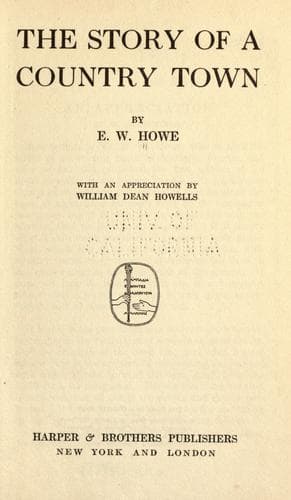
The Story of a Country TownHowe, E. W. (Edgar Watson)
General
The Story of a Country Town
Howe, E. W. (Edgar Watson)
Frontier and pioneer life -- Kansas -- Fiction
“You know why I went out of the house to-night. It is nothing more than
that; you say it is not serious.”
Mateel walked over to a chair near me--I thought she staggered as she
went--and sat down, and her face was so pale and frightened that I felt
sure Jo wronged her when he said she did not care. We sat there so long
in silence that I began wondering who would first speak, and what would
be said, and whether it would clear up this distressing matter. When I
glanced at Mateel, I saw despair and helplessness written in her face,
and determined to go to bed, and leave them alone, hoping they would
talk it over, and forget it. Jo saw my intention, and motioned me back.
“You say it is not serious,” he said, glancing hurriedly at his wife, as
if afraid that if he looked in her face, and saw its distress, his
stubborn heart would relent so much so as to commit the unpardonable
offense of taking her in his arms; “therefore you will not care that I
have told Ned. I have talked to him more freely than to you. I went to
town for that purpose.”
Had my life depended upon it, I could not have told which one I pitied
most.
“As I know you to be a truthful woman,” he went on, after a long pause,
“and you say it is not serious, I believe that you think so; but it is
all the more unfortunate on that account, for it is a very grave matter
to me. I can never explain to you fully why I take it so much to heart,
because I should wound your feelings in doing it, but the change in me
within six weeks will convince you that if I am unreasonable about it, I
cannot help it, and that my pride has been humbled, and my spirit
broken, by a circumstance for which you are probably not to blame, when
everything is considered. It is unmanly in me to feel as I do, and I
apologize to you that I have not manhood sufficient (if that is a
reasonable excuse) to shake off a circumstance which will affect my
future, but which you regard as trifling. I have loved you--and I do
yet; it is nothing to me what those I do not care for have been--I have
loved you with my whole heart, and I have never divided my affection
with anyone, if I except an honest friendship for my sister’s son, and
who was the sole companion of my wretched boyhood; but the more I love
you, the more unhappy I am. This is my unfortunate dilemma, and I only
mention it because the serious truth must be known. Although it nearly
killed me, I asked you never to show me affection until I felt
differently; I did this because I believed you learned to be
affectionate with a man I hate, and that you can never show me an act of
kindness you did not show him, and which your love for him taught you.
No woman’s lips ever touched mine--my only sister’s alone excepted, and
hers not frequently--until yours did; my mind was never occupied with
thoughts of love until I met you, and now that I know you only consented
to marry me because you could not be better suited, my simple affection
is hurt.
Public-domain text, read in full here on John Shaqi.
Reviews
Reviews
No reviews yet
Be the first to share your thoughts on this work.
Elsewhere in the archive
Join the Discussion
Join the discussion
Sign in to leave a comment or review.
Sign InorCreate an account