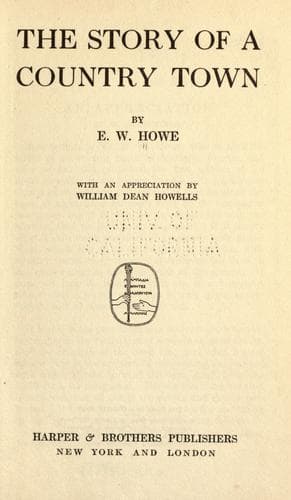
The Story of a Country TownHowe, E. W. (Edgar Watson)
General
The Story of a Country Town
Howe, E. W. (Edgar Watson)
Frontier and pioneer life -- Kansas -- Fiction
“It is my most serious fault that I did not tell him of it before we
were married; but I was timid, and thought of it only as one of the many
little regrets with which every life is filled, and neglected it. I
could not love my husband more than I do, and I only failed to tell him
of it because I feared it would give him unnecessary pain. I was but
sixteen then; a school-girl without serious thought or purpose, and
certainly every one of my companions was as guilty as I, if it can be
called guilt. It is not necessary for me to make explanations, for he
has given me notice that they will not be accepted, but if there is
anything I can do to make atonement--no difference what it is; even to
going away from him, and dying alone and neglected--I will gladly do it,
and humble myself cheerfully if that course will relieve him. I have so
much confidence in my husband that I do not question the honesty of his
grief, and for his sake I regret my past. In justice to my womanhood I
cannot say I am ashamed of it. If I mentioned a name which was obnoxious
to my husband in my sleep, it was because the name had caused me
trouble. I do not remember it, for since this unhappy change in our
home I have been ill and worn out. I was never strong, but I am so weak
now as to be helpless.”
Jo seemed to not pay the slightest attention while his wife was talking,
for he kept his eyes on the floor, but that he was listening intently I
knew very well. Mateel looked at him timidly when she had finished, as
if expecting a reply, but as he made none, she too looked at the floor.
I watched her face narrowly, and there saw depicted such misery as I can
never forget. She seemed to realize that she had made her husband
unhappy by a thoughtless act, and to realize her utter inability to
supply a remedy. I think a more ingenious woman could have made a more
cautious statement, though not a more honest one, and won her husband
back by explanations; but Mateel, as was the case with her father, gave
up at once on the approach of a difficulty, and prepared for the worst.
I saw in her face that she would never be able to effect a
reconciliation; for, believing it to be hopeless, she would be dumb in
contemplating the life they would lead in future. I knew she would be
kind and attentive, and hope for the best, but in her fright and
consternation she could not gather strength to test her ingenuity. I
knew that she would accept her husband’s increasing obstinacy as
evidence that a great calamity had come upon their house, and meekly
submit, instead of resolving to conquer and triumph over it. If she had
put her arms around his neck then (as he wanted her to do, in spite of
his commands to the contrary), and, between declarations of her love,
asked him to give her a year in which to prove her devotion, and explain
away the unhappy past, I believe this story would never have been
written, but they misunderstood each other at the beginning, and
continued it until the end.
Public-domain text, read in full here on John Shaqi.
Reviews
Reviews
No reviews yet
Be the first to share your thoughts on this work.
Elsewhere in the archive
Join the Discussion
Join the discussion
Sign in to leave a comment or review.
Sign InorCreate an account