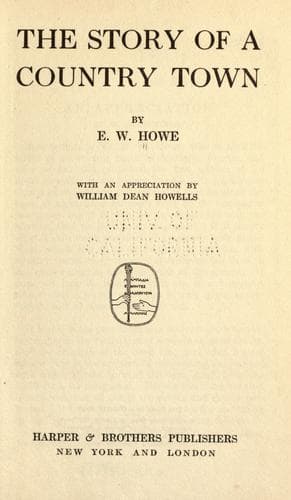
The Story of a Country TownHowe, E. W. (Edgar Watson)
General
The Story of a Country Town
Howe, E. W. (Edgar Watson)
Frontier and pioneer life -- Kansas -- Fiction
It was peculiar to my business that the people could see at the end of
every week all that had been accomplished, and it was usually so little
(though I did the best I could) that I felt ashamed of it, and dreaded
to see a stranger pick up the “Union of States” in my presence, for fear
he would not know my connection with it and make unfavorable comment. I
frequently left a public place on this account, and I never came
suddenly upon a knot of men that I did not hurriedly announce my
presence, so that if they were pointing out the most glaring defects of
the paper, they could spare me the humiliation of listening to them.
Other trades and professions are more secret, and their contemptible
transactions generously hid from the public, but all my work had to be
submitted to the criticism of every idle vagrant who cared to pick up
the sheet. A lawyer or a merchant might lock himself up in his office,
and pretend to be engaged in grave affairs while really idling time
away, but if I had attempted it, the deception would have been apparent
at once. Public attention is always called to a newspaper, for otherwise
it cannot prosper, and so the people are usually disgusted when they
realize how little a man can do, papers of the class I published were
not popular. Other men’s affairs were equally contemptible, but they
were charitably hid from the public gaze, whereas mine were regarded as
common property, and fault found accordingly. I did not know then,
though I have since found it out, that what one complains of will please
another, so that when a paper makes an enemy, it makes a friend with the
same paragraph, though the enemy takes more pains to talk about it than
the gentleman who is quietly delighted.
It is my opinion that to become too well known is dangerous, for under
such circumstances your faults are common property, and your
insignificance proverbial, and a man who writes long for a newspaper
will inevitably show every weakness of which he is possessed. Each week
I laid before the people every thought, every idea, and every suggestion
I was possessed of, and became so tired of being criticised that I would
have given ten years of my life for half a year’s vacation. When Martin
grew tired (he was at first a valuable assistant, but his enthusiasm,
like mine, did not last long), he coolly said he was worn out; but I had
no one to whom I could make that excuse, and was compelled to get along
the best I could. I was subject to the beck and nod of every ridiculous
man in the community, for every citizen thought it his duty to give me
good advice if he did not give me patronage, and though I longed to
retaliate by pointing out the offences of some of them, I found it
politic to hold my peace. Occasionally I wrote a very good thing (at
least, occasionally I attracted attention), but nobody gave me credit
for it, and it was attributed to some one in the town who could not
write an ordinary business letter without lolling out his tongue.
Public-domain text, read in full here on John Shaqi.
Reviews
Reviews
No reviews yet
Be the first to share your thoughts on this work.
Elsewhere in the archive
Join the Discussion
Join the discussion
Sign in to leave a comment or review.
Sign InorCreate an account