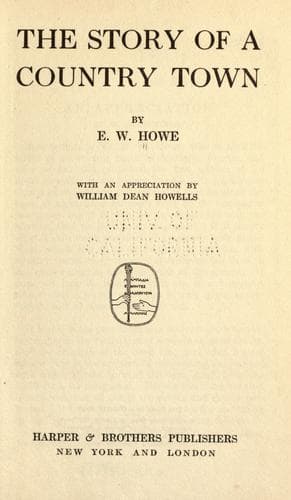
The Story of a Country TownHowe, E. W. (Edgar Watson)
General
The Story of a Country Town
Howe, E. W. (Edgar Watson)
Frontier and pioneer life -- Kansas -- Fiction
In the afternoon I drove over to the Smoky Hill country, leaving Big
Adam to follow at his leisure, as he showed a disposition to dissipate
until night, and after arriving at Mr. Biggs’, I put the horses away in
the stable I had become familiar with on my first visit to the place,
the stalls of which were still oozy and wet, and went up to the house.
Although I disliked to disturb the quiet of the place, I was compelled
to ring the bell, for there was no other way of attracting attention,
and after a little while Agnes came to open the door. Instead of
speaking to me, she burst out crying, and, in involuntary pity for her
distress, I took her in my arms, to which she made no resistance, but
sobbed softly as I tried to comfort her with pitying words. I did not
even think of my arms being about her, or that her head rested on my
shoulder, and for the first time in several years I felt natural in her
presence.
From where we stood in the hall I could see through an open door a plain
coffin, supported at each end with a chair, in the room where I had sat
with Biggs on my first visit to the house. I was impressed that it held
a friendless body, for the coffin was not ornamented in any way, and had
evidently been hurriedly made by a country carpenter. The top was shut
down, as though there were no friends anxious to look frequently at the
face, and for the first time I felt sympathy for the dead. It was no
doubt very absurd in me, but I had almost expected to find the family in
good spirits on my arrival, for I had never had a kindly thought for
Mrs. Deming in my life. Her brother never mentioned her at all; her only
child did not, except when it was necessary, and Big Adam had told me so
much of her disagreeable qualities that I was very much prejudiced
against her, but when I found that no one but members of her own family
were there during her sickness and death, I felt kindly toward her
memory, and thought that Big Adam had certainly misrepresented her. The
distress of Agnes, which continued after we were seated in the room
where the coffin was, also convinced me there must have been some good
in the dead woman, and as the room began to grow dark from the going
down of the sun, I thought that her life had been a night, which I hoped
would be followed by a glorious morning.
I heard while at the house--it may have been from her old enemy, who
returned from town in the course of the night, whistling all the wild
airs I had ever heard--that the family had not a single acquaintance in
the neighborhood, and that no one came to the house, except a farmer
occasionally to see Mr. Biggs on business; that the people all believed
Mrs. Deming to be a witch, and that they kept horse-shoes and charms in
their houses from dread of her. Although many of them knew and admired
pretty Agnes, they believed she had been stolen by Mrs. Deming when very
young, and were always expecting some one to arrive and claim her.
Public-domain text, read in full here on John Shaqi.
Reviews
Reviews
No reviews yet
Be the first to share your thoughts on this work.
Elsewhere in the archive
Join the Discussion
Join the discussion
Sign in to leave a comment or review.
Sign InorCreate an account