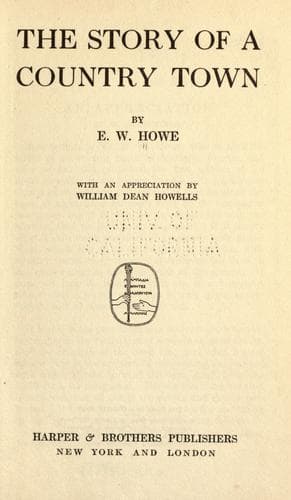
The Story of a Country TownHowe, E. W. (Edgar Watson)
General
The Story of a Country Town
Howe, E. W. (Edgar Watson)
Frontier and pioneer life -- Kansas -- Fiction
“Taking a man, for example, when it is first known that he is to have an
existence, his mother cries, and his father says he wouldn’t have had it
happen for the world, or for fifty thousand dollars, although he may not
have a dollar he can truthfully call his own. After a season of piling
his clothes all in one place at night on the part of the coming man’s
father, and grief and suffering on the part of his mother, he is finally
born, and the women of the neighborhood come in to see which one of his
parents he resembles, although it should be known beforehand that he
will be like the uglier one in face and disposition. This may ALWAYS be
depended upon; it NEVER fails. When he is a month old, or on the first
regular bill-day after his birth, his father quarrels with the doctor
for bringing him into the world at all, and pays the price in great
anger, and under protest, vowing that he will never again give the old
quack opportunity to rob him. When he is three or four months old, his
father and mother quarrel as to whether he shall be named for her people
or his folks. This settled, he is attacked with colic, followed in rapid
succession by the numerous distressing complaints which nobody ever
escaped. After this comes his boyhood, which he always remembers as
being particularly disagreeable, as he never gets enough to eat, and is
constantly being found fault with and whipped. At last he is started to
school, where a man who is a tyrant because he is not a lawyer (or a
woman who is cross because she is not married) endures him during the
hours of the day when the outside is most attractive. From this he runs
away, and serves an apprenticeship with the world, making so many
mistakes, and doing so many foolish things, that he is crestfallen the
remainder of his life. Then he marries the wrong woman, and has the
experience of his father over again, meanwhile working like a slave to
get something ahead. But he does not succeed, as he has a faculty of
doing that which he ought not to do, although he strives very earnestly
to become a great man, and make his father ashamed of himself, and after
a life of misery, a boy comes out of his front door on a morning after a
stormy and windy night, and hangs crape on the knob. If there is a
newspaper in the town where he lives, he is given a magnificent column,
to induce the relatives to buy large numbers of extra copies to send
away. The next day a hearse and six gentlemen in black clothes and white
cotton gloves appear at his front gate. The neighbors come straggling in
to see what the mourners will do, and an hour after that a surly sexton,
who is wondering who will pay him, begins to rattle clods on his coffin,
whereupon the carriages on the outer edge begin to drive hurriedly away,
as if too much time had been spent with him already, and in a few
minutes he is an inhabitant of the silent city whose residents quietly
wait to be gathered as brands for the burning. If he happened to be
Public-domain text, read in full here on John Shaqi.
Reviews
Reviews
No reviews yet
Be the first to share your thoughts on this work.
Elsewhere in the archive
Join the Discussion
Join the discussion
Sign in to leave a comment or review.
Sign InorCreate an account