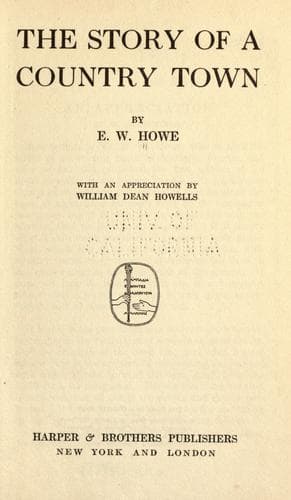
The Story of a Country TownHowe, E. W. (Edgar Watson)
General
The Story of a Country Town
Howe, E. W. (Edgar Watson)
Frontier and pioneer life -- Kansas -- Fiction
Another one tells of an eccentric bachelor who meets a pale but
strikingly beautiful girl on the street on a cold winter’s night. He
once loved a face like that, and interested himself in the girl. In
course of time it developed that the bachelor had been engaged to the
girl’s mother, and that they were separated by some sort of an
unfortunate mistake, and she married a man who was willing to support
her in her grief, but who unfortunately died, and could no longer feed
her while she mourned. Humiliated and broken, she refused to return to
her old friends, but lived with her only daughter in poverty, talking a
great deal of her lover, but not a word of the poor fellow who had been
her husband. When she finds death approaching she writes a letter to her
lover, consigning the girl to his care, and the letter of course falls
into his hands, which affects him so much that he surprised his friends
by marrying the daughter. I suppose the inference is that Mateel,
acknowledging her own weakness, desired Bragg to understand that she
would only consent to marry another man with the hope of rearing a
daughter good enough for him.
There have been a few sweet chords of music in my life (a very, very
few, and simple in construction), but while never complete in my
boyhood, I have listened to them in my lonely hours with a great deal of
pleasure. They were the whisperings of hope; of happiness which I had
never known, but now the familiar air scarcely begins until it is lost
in the yells of demons and the harsh laughter of devils. I do not know
whether I read it, or dreamed it, but there was once a deep cave said to
be haunted. The people who went there without lights, and did not speak
for a long while, heard the beginning of the most delicious symphony, as
sweet and perfect as the music of the choirs in heaven, but suddenly it
was all lost in coarse uproar and laughter, as if the Devil and his imps
were flushed with wine at a banquet, and were telling each other of the
follies of men, to laugh at them. This dreadful tumult continued until
the music was quite forgotten, and no one could remember the strain,
although they all said it was very tender and beautiful. Sometimes the
people who went there would hear neither the music nor the tumult which
always broke into it, but this always happened when the night was fine,
and the visitors noisy and in good spirits. But every dark and
threatening night, when the wind came hurrying down from the north to be
present at the destruction threatened, those who went into the cave
always heard the music, and it was notably tender and touching on such
occasions, but the devils broke into it more quickly, and were hoarser
and louder in their laughing and jeering.
Public-domain text, read in full here on John Shaqi.
Reviews
Reviews
No reviews yet
Be the first to share your thoughts on this work.
Elsewhere in the archive
Join the Discussion
Join the discussion
Sign in to leave a comment or review.
Sign InorCreate an account