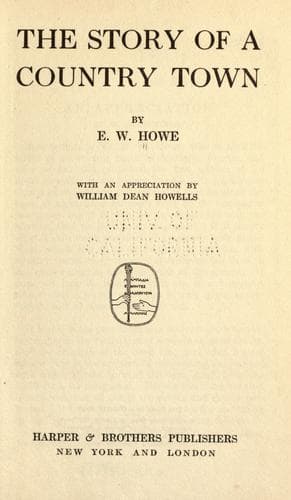
The Story of a Country TownHowe, E. W. (Edgar Watson)
General
The Story of a Country Town
Howe, E. W. (Edgar Watson)
Frontier and pioneer life -- Kansas -- Fiction
Other men’s wives were intellectual if not beautiful, or beautiful if
not intellectual, but mine was neither. It is my candid judgment, and I
write it with sorrow and pity, that she had not a single good quality.
(I have thought it all over, before proceeding, and assert it again: Not
one.) I think she never went to bed in her life that she did not drink
some sort of tea for some sort of complaint, and it was her only boast
that in all the world a woman could not be found who “bore up” as well
as she did. She took pride in nothing else; she had no other ambition
than to demonstrate that such was the case, and had no other delight
than to cite evidences of it. I beg you will remember that these are
cold, calculated assertions of fact, and not illustrative in any degree.
I have spent several weeks in writing this letter, in a manner that
cannot be misconstrued; every word has been weighed, and put down after
its effect and the impression it would convey had been carefully
considered.
She took not the slightest interest in me nor my affairs; indeed, she
took interest in nothing except her family, which worried her so much
that frequently she awakened in the night, and cried for hours like a
silly child for fear her mother, or her father, or her brothers, or her
sisters, were not well, although there would not be the slightest reason
to suppose they were not enjoying their usual health. This circumstance
is particularly worthy of note when it is known that she did not get
along with her family, for they were always quarrelling when together,
and although they were the most ordinary people, she talked of them, and
wondered what would they say to this or that, so much that I gently
remonstrated with her. This she construed into an attack, and while I
lived with her she regularly vindicated “her family” whenever I came
into her presence, in a manner indicating that they were of royal blood.
They moved away from there after we had been married a few years, and
this gave her occasion to bewail her separation from them, which she
never lost opportunity to do. Her father was a perfect type of a common
man; the mother was a little better, perhaps, but the brothers and
sisters did not average with the young people in the poor town where
they were brought up, so that this great admiration was unwarranted, and
ridiculous. But if it were disagreeable when “her family” were in the
same town with us, it was unbearable when they were away. For every
month of their separation she added a hall, park or castle to her
father’s possessions--which consisted in reality of battered household
goods that a really vigorous man could have carried away on his back.
Finally I began to think seriously of running away.
Public-domain text, read in full here on John Shaqi.
Reviews
Reviews
No reviews yet
Be the first to share your thoughts on this work.
Elsewhere in the archive
Join the Discussion
Join the discussion
Sign in to leave a comment or review.
Sign InorCreate an account