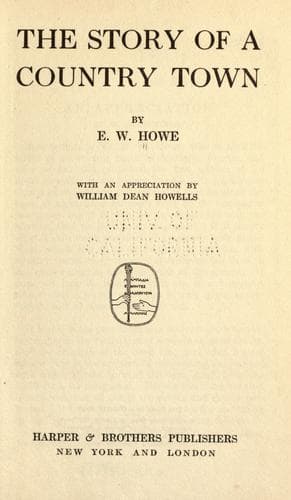
The Story of a Country TownHowe, E. W. (Edgar Watson)
General
The Story of a Country Town
Howe, E. W. (Edgar Watson)
Frontier and pioneer life -- Kansas -- Fiction
He said to me often that nothing was so distasteful to him as wrangles
over business affairs, as if nothing in the world was so important as
the possession of money, and that he allowed himself to be robbed rather
than dispute and quarrel, which knowledge I am afraid his customers
often used to their own advantage. His business remained profitable, I
also heard him say, because he had to keep busy to avoid
self-destruction, and that motive seemed to succeed quite as well as the
nobler one of ambition.
If he came to the house, and met my mother, her painful condition had a
bad effect upon him, so that he finally avoided her, usually coming to
the office in the evenings when he knew I should be there. I think she
never knew he was in trouble, for I never told her, and she seldom
talked to any one else, though she must have wondered at the remarkable
change in his manner, for he had grown nervous to a painful degree, and
looked anxiously about like a hunted man. Usually when he came to Twin
Mounds he had no other errand than to be with me for a few hours; at
these times he would go over his painful story in detail, and, in
explaining his wretchedness, try to justify himself, talking of it in
such a pitiful way that I became nervous myself in trying to devise some
way out of the difficulty. He talked a great deal of how the people
would blame him if they knew the story; how they would say his brain was
softening, or that he ought to be sent to an asylum, and then he would
put the case to me again, and ask me to judge if his trouble was not
justified. I always believed that it was, more because I knew that my
friend, a man of promise, was in distress, than because I had
impartially judged it, and so I always told him, but this gave him
little satisfaction, for he said that in my friendship for him perhaps I
did not do Mateel the justice she deserved.
When the weather was fine, I drove him home at night, and I think we
always met Bragg driving toward the town. Except that he was more of a
dog than ever, there was little change in the fellow, and he moped about
in his usual listless fashion, doing nothing but mischief, and
occasionally becoming maudlin from drinking out of his bottle. He
probably watched Jo’s coming that he might meet him on the road as an
annoyance, and I always trembled when I saw them meet, for Jo’s hatred
for him was intense, and he would have been delighted with the slightest
excuse to beat him.
Public-domain text, read in full here on John Shaqi.
Reviews
Reviews
No reviews yet
Be the first to share your thoughts on this work.
Elsewhere in the archive
Join the Discussion
Join the discussion
Sign in to leave a comment or review.
Sign InorCreate an account