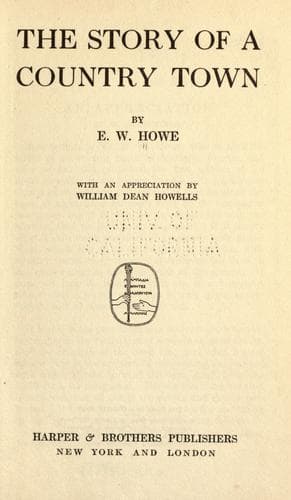
The Story of a Country TownHowe, E. W. (Edgar Watson)
General
The Story of a Country Town
Howe, E. W. (Edgar Watson)
Frontier and pioneer life -- Kansas -- Fiction
When I hurried into the house I saw that my mother’s room was full of
pitying faces, and that the people made way for me as I approached the
pale form on the bed. I was so frightened that I could do nothing but
kneel down, and burst into tears, and while I knelt thus I knew that my
mother’s hand was placed lovingly on my head. When I recovered
sufficient composure to look at her, I saw that she was lying precisely
as I had left Jo; her arms thrown out carelessly on either side, and
there were tears in her eyes, and a look of inexpressible grief on her
face. Occasionally she took a long breath, and sobbed, as her brother
had done, and she turned her head away from me, as he had done, but not
until I saw that there was blood on her lips, when it was softly
explained in answer to my look of alarm that she had had a hæmorrhage. I
tried to make myself believe that it was but an attack which would soon
be over, but the people who were gathered about were so serious that my
tears came afresh, and I could do nothing but hope.
She had turned her face away from me, and remained in that position so
long that it was suggested that perhaps she was asleep. Some one went
softly around to that side of the room to see her face, and looking at
the others in quick alarm, they came crowding around the bed: the
patient watcher was dead.
Let the bleak winds take up the cry of the unhappy son, and carry it
across rivers and fields to the wanderer, that he need not return; that
the light in the window has gone out, and that the watcher who waited so
long to forgive him is dead. Let them look for him in all the places
where hunted men hide, and deliver the message that a pitying angel
came, and, taking the light which offered forgiveness and peace so long,
planted it in the heavens, where it will remain forever, a pitying star,
offering mercy to all men who are weary and in distress.
CHAPTER XXVIII.
TOO LATE.
The fall of snow continued through the night, and during the following
day, and there was grave doubt whether those who had been sent for could
arrive in time for the funeral, for great drifts had collected in the
roads, and it was very cold. The people who came in talked more of the
weather than of the dead, and it was whispered among them that such a
storm had never been known before in the history of the country. A man
who had been out to dig the grave came in and whispered to his wife that
the ground was frozen to a wonderful depth, and that those who were
helping him could only work a few minutes at a time, and that the grave
filled up with drifting snow almost as fast as they could throw it out.
Public-domain text, read in full here on John Shaqi.
Reviews
Reviews
No reviews yet
Be the first to share your thoughts on this work.
Elsewhere in the archive
Join the Discussion
Join the discussion
Sign in to leave a comment or review.
Sign InorCreate an account