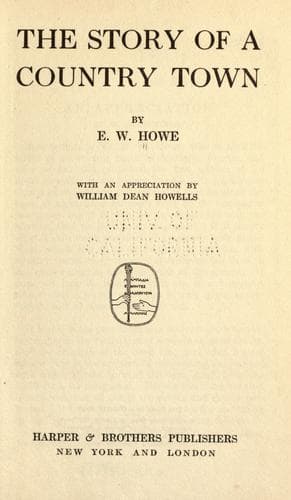
The Story of a Country TownHowe, E. W. (Edgar Watson)
General
The Story of a Country Town
Howe, E. W. (Edgar Watson)
Frontier and pioneer life -- Kansas -- Fiction
He only mentioned his horror of the empty house at night in general
terms, but I have always been convinced that his greatest trial was his
loneliness, and that he would have closed the place and left it but for
the hope that Mateel would surely come to-morrow; not as a humble
suppliant, but as his wife, with a request that she be allowed to occupy
her old place in the house, if not in his heart. Had Mateel opened the
right door to his heart she would have found such a wealth of love and
consideration there that she would never have ceased trying to reclaim
it, for his love for her was so great that he could not have resisted
the smallest effort. I do not remember that I thought this until I went
to his house a half year after the separation, but I firmly believed it
then, and I believe it yet. Perhaps I shall be better understood if I
explain that while Jo was frequently at fault before the separation, six
months of loneliness had wrought a great change in him, and he was
willing to admit that his estimate of women was too high; that they were
weak like himself, and that he was to blame for having made a serious
matter of love. In the early days of his acquaintance with Mateel he had
worshipped her as an angel rather than admired her as a woman, but he
was now ready to give up his idol, and forgive her faults as she forgave
his. He had regarded his marriage as a piece of unusual good fortune,
whereby he secured a perfect being who would bring him only happiness in
her train, but the experience of a few years had taught him that it was
only a ceremony pledging two persons to charity for the failings of each
other.
Many times after that I got up from my bed at night, after thinking
about it, determined to go to Mateel, and tell her of my conviction, but
upon consideration would conclude that she must know it, and that she
did not desire a reconciliation. Although there was always an unspoken
hope that such was not the case, Jo probably took this view of it--that
she preferred to live without him. Perhaps I had better say that he did
not ask her to come back for fear of the humiliating reply that she did
not care to come, for he was always in doubt with reference to her.
When there was occasion Jo ran the mill at night, preferring to be there
at work than alone in the house, and he was seldom in the mill at any
other time, trusting his business almost entirely to his assistant, who,
fortunately, was capable of managing it with Jo’s advice. He told me
after we had finished an early supper that he was to take charge at
seven o’clock, and when that hour arrived we went down there and were
soon alone. There was little to do, except to see that everything was
running smoothly, and by the time Jo had made a general inspection it
was dark, and we were seated in the largest room without a light, with
nothing to disturb us except the subdued hum of the machinery, and the
gentle fall of the water.
Public-domain text, read in full here on John Shaqi.
Reviews
Reviews
No reviews yet
Be the first to share your thoughts on this work.
Elsewhere in the archive
Join the Discussion
Join the discussion
Sign in to leave a comment or review.
Sign InorCreate an account