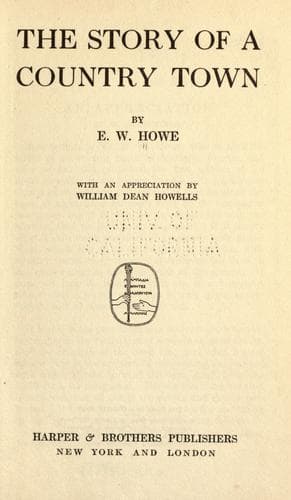
The Story of a Country TownHowe, E. W. (Edgar Watson)
General
The Story of a Country Town
Howe, E. W. (Edgar Watson)
Frontier and pioneer life -- Kansas -- Fiction
This was so ridiculous, and so like Jo, that I was really amused, though
apparently he could not see why I should be, for he looked up in
surprise at my merriment.
“I have never doubted that Mateel was constantly trying to do that which
was right, but her nature was such that, although I recognized that she
was a good woman, I was never contented. Perhaps this was wicked in me,
but I always did the best I could, though in my weakness I was very
often wrong. I despair of being able to explain to any one exactly what
I mean, and probably I shall always seem to have been a ridiculous and
unreasonable man, though I can fully justify myself in protesting
against a life without hope. I only regret that Mateel is not as much
concerned as I am, for then there would be a possibility of bridging the
difficulty. When I think how careful you are of my wishes, and how
easily you please me, I cannot help remembering how innocently Mateel
did that which was distasteful, though all the time I realized that she
was upright and honest, and a better woman than I was a man. I can only
say in excuse of my conduct that the more contemptible I became in all
other eyes than yours and my own--I believe you would love me even
though I should commit murder--the more I hoped Mateel would realize the
necessity of hunting out a remedy, and applying it, for I thought I
would rather die than live as wretchedly as I did, but matters have
grown steadily worse, and instead of understanding that whatever I did
was prompted by love for her, she seems to believe that I am depraved
and wicked. She had great sympathy for everybody and everything except
me, and I have frequently found her weeping over a newspaper scrap when
I was so much in need of her sympathy that I almost asked it on my
knees. She was always thinking of the unfortunate birds, the unfortunate
people, or worrying over distress of some kind, but upon my honor she
never in her life, of her own motion, had any sympathy for my affairs. I
was always robust, but occasionally I regretted that she was not anxious
about my health. I never worked too hard, but I regretted she did not
think so, and remonstrate with me in such a way as to prove that she had
an interest in me. Before we were married and when I was building the
mill, I worked harder than any man had ever before worked in Fairview,
and really became quite pale and wan, but she never mentioned it.
Although I was glad to do what I did for her, it would have pleased me
had she said I was a worthy man for it, and encouraged me a little. I
suppose she thought everything came to me naturally and easily, but it
did not. Or she may have thought that much that I did for her was the
work of the Lord. What makes me most miserable of all, however, is the
certainty that she possesses all the womanly tenderness I feel the lack
of, but I was not the man to bring it out. It was the misfortune of both
of us.”
Public-domain text, read in full here on John Shaqi.
Reviews
Reviews
No reviews yet
Be the first to share your thoughts on this work.
Elsewhere in the archive
Join the Discussion
Join the discussion
Sign in to leave a comment or review.
Sign InorCreate an account