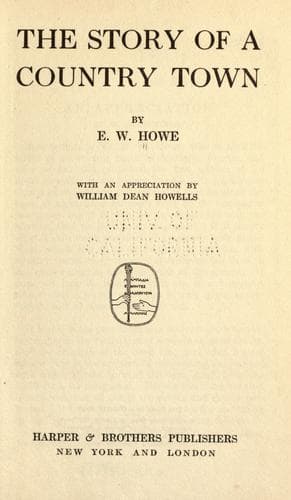
The Story of a Country TownHowe, E. W. (Edgar Watson)
General
The Story of a Country Town
Howe, E. W. (Edgar Watson)
Frontier and pioneer life -- Kansas -- Fiction
Barker was never a man of words, and he expressed no opinion about the
matter, although he frequently said that at any time I needed him, I had
only to say the word, no matter what the service might be. If he was at
a loss to understand the difference between Jo’s case and his own, he
did not mention it, and held his peace. When he went to the prison to
see Jo in the evening, I thought his word of greeting was almost a sob,
as I remember him on the night he came to claim Agnes, but he soon
recovered himself, and we spent the evening quite pleasantly. Big Adam,
who accompanied us, spent his time in critically examining the bars at
the windows, and in testing their strength, and he apparently became
convinced that there was little hope in that direction, and that the
only thing to do was to storm it from the outside. During the evening he
wrote a note and asked me to deliver it to the sheriff, and after he
went away I looked at it. It began, “My opinion of the officer,”
followed by the largest number of blasphemous words I have ever seen
collected, though they had no reference to each other, every one being
complete in itself, as an expression of hate. There were also a great
many vile words mixed in with the blasphemous ones, and at the bottom he
signed his name in full, whereby I came into possession of the fact that
his full name was John Adam Casebolt.
At this time I cannot remember how long it was before Bragg’s father
came, but within an hour after his arrival he walked quietly into the
office, and, after waiting my pleasure, asked me to tell the story of
his son’s death. He was a distressed sort of a man, as though he had had
a great deal of trouble in his life, and I honestly tried to tell the
circumstances of the death without prejudice. Of Bragg’s systematic
persecution of Jo; of his aimless excursions past his house; of his
insolence and over-bearance, I spoke at considerable length, and
detailed numerous instances when I knew he had passed the mill at
midnight, though he had not been at the Shepherds’. I told him of his
son’s renewed attentions after the separation, though he had been the
cause of it, and I expressed the opinion that he had brought about the
marriage, not for love of Mateel, but for revenge on a man who had never
harmed him, for she was such a hopeless invalid that marriage with any
one was the merest farce.
He made no replies to anything I said, but occasionally asked a question
to make a point clearer, and when I had finished, he thanked me for my
trouble, and went out, walking past the jail on his way back to the
hotel, and I thought he peered curiously up at the windows, as if he
were anxious to see Jo.
I saw him a great deal after that, and knew that he was in consultation
with an attorney, but he talked to no one else. After remaining two or
three weeks, he quietly disappeared, and it was learned that he had
returned home, leaving his case in the hands of the public prosecutor.
Public-domain text, read in full here on John Shaqi.
Reviews
Reviews
No reviews yet
Be the first to share your thoughts on this work.
Elsewhere in the archive
Join the Discussion
Join the discussion
Sign in to leave a comment or review.
Sign InorCreate an account