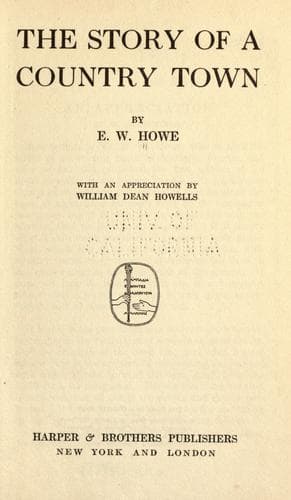
The Story of a Country TownHowe, E. W. (Edgar Watson)
General
The Story of a Country Town
Howe, E. W. (Edgar Watson)
Frontier and pioneer life -- Kansas -- Fiction
“Are you quite sure that you fully forgive me for my desperate crime?”
“Yes, Jo.”
“I might have been a credit to you instead of a disgrace had I acted
differently,” he said, turning on his side to look at me. “When you were
reading just now I thought of the afternoon in Fairview when we went out
to the hayloft to talk of our future, after it was announced that I was
to go to Damon Barker’s to live, and I thought that while we have turned
out very much as we hoped we should, you were brave and patient in your
sorrow, while I was utterly cast down by mine and ruined. Do you forgive
me for that?”
“Yes, Jo; everything. I love you so much that I cannot think of your
faults.”
He turned on his back again, and remained quiet so long that I, too,
thought of the Sunday afternoon in Fairview, and of what he had said. Jo
was evidently thinking of the same thing, for at last he continued:--
“I remember of your mother saying to me once that she believed you and I
would grow up into brave and honorable men; men who would love their
wives and children instead of treating them as they were treated in
Fairview, and I feel very guilty now that I realize that she was
mistaken in her opinion of me. It would have been genuine bravery had I
conquered my horror of the letter, my hate for Clinton Bragg, and made
Mateel love me in spite of everything; but I did not know what the word
meant then, though I do now, and your mother probably meant something
like that. My boyhood was so wretched that I expected relief from
wretchedness when I was married, but perhaps I should have known that
unhappiness attends every condition in life, and that bravery and
nobility consists in forgiving and forgetting, together with gentleness
and capacity. My life has been one long mistake; I should think you
would find it hard to forgive that, after expecting so much of me.”
“No, Jo; not at all hard. If you are entitled to charity from me, I gave
it without knowing it, for I only think of you to regret that a man so
worthy has been so unfortunate. I never reproached you in my life.”
“Although I believe you forgive me fully,” he continued, “I cannot
forgive myself, though I confess my weakness, and say that I always did
the best I could. I conquered everything except shame over the contents
of the letter and hate at the sight of Bragg. These dragged me down as
discontent dragged John Westlock down; perhaps any man could be ruined
if attacked at the right place.”
Wiser men than you, Jo, are of that opinion, and I regarded it as the
most eloquent defence he had ever made. Those who believe in their own
strength have great charity for themselves and none at all for others,
but those of us who are more candid, and learned in the world’s affairs,
acknowledge our own weakness in admitting the weakness of others.
Public-domain text, read in full here on John Shaqi.
Reviews
Reviews
No reviews yet
Be the first to share your thoughts on this work.
Elsewhere in the archive
Join the Discussion
Join the discussion
Sign in to leave a comment or review.
Sign InorCreate an account