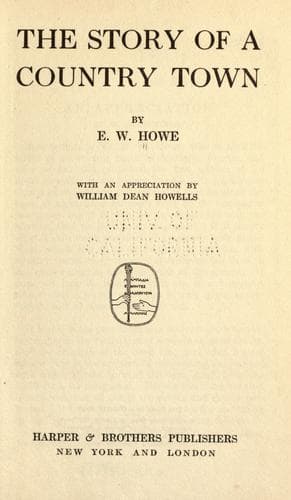
The Story of a Country TownHowe, E. W. (Edgar Watson)
General
The Story of a Country Town
Howe, E. W. (Edgar Watson)
Frontier and pioneer life -- Kansas -- Fiction
“You must not go away feeling down at heart, or ill at ease, but
cheerful,” he said, when I confessed that I was going to Barker’s in his
behalf. “I will tell you something that will please you. I have studied
over this matter a great deal during the past few weeks, and have come
to a conclusion that will relieve us all. I will only say now that it
will end all confusion and worry, and that it is the very best thing
that can be done. I know that you have confidence in my judgment, and
will be content to wait until you return, when you shall know all. It is
not a plan that will cause you more trouble, but one that will be a
relief to you, therefore be as happy as you can while away, and carry my
kindest wishes to Agnes and her father. Tell them that I am well, and
that in a little while we shall be through worrying over this matter,
for I have hit upon a plan to relieve us of it. It is sure to work, tell
them, and that they need not fear as to that. I may say it is the only
thing that can be done, which you will be glad to hear, for it is
sometimes hard to hit upon the right plan, but after a great deal of
thought I have it. You feel better now, do you not?”
I answered him that I did, which was the case, for I believed that while
I was away during the day he was thinking, and hoped that he had hit
upon something that would meet with the approval of all his friends.
Probably it was an escape, and a life in some distant country, where I
would join him in course of time, or perhaps a plea of self-defence,
backed by circumstances of which I knew nothing, but at any rate I was
sure the plan was a good one, for Jo did not often make mistakes in
such matters, and I felt a relief of which I was greatly in need. I
determined at once to bring Barker back with me to hear the plan, and
aid in its execution.
“You look happier to-day,” he said, taking both my hands in his own,
“than I have seen you in a long while. I am very glad of that, and I
hope I, too, look pleasant, for I am sure the plan is a good one. Do I
not look much as I did when we were happy boys together; when I was your
good friend, and loved you more than any one else in the world? Look at
me and answer.”
I did as he requested, and saw that there was the old cheerfulness in
his smile, as there had been the old tenderness in his voice.
“A little older, and a little paler,” I replied, “but certainly you look
more natural to me this moment than you have for four years. And you
look more like my old friend, too; for when we were boys, and you told
me of your friendship, you were so earnest and feeling that tears came
into your eyes. There are tears in your eyes now.”
He did not brush them away, as I expected he would, but let them roll
down his cheeks and fall to the floor.
“I did not know there were tears in my eyes until you spoke,” he said.
“But they are only tears of gratitude that I am permitted to have one
friend like you.”
Public-domain text, read in full here on John Shaqi.
Reviews
Reviews
No reviews yet
Be the first to share your thoughts on this work.
Elsewhere in the archive
Join the Discussion
Join the discussion
Sign in to leave a comment or review.
Sign InorCreate an account