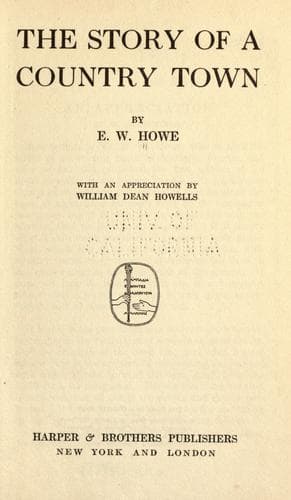
The Story of a Country TownHowe, E. W. (Edgar Watson)
General
The Story of a Country Town
Howe, E. W. (Edgar Watson)
Frontier and pioneer life -- Kansas -- Fiction
“Agnes is like him. It will be a great relief to her to go home with
you. Does she ever talk of her mother?”
“No,” I answered.
“I thought not; nor does she ever talk of the Devil. But I’ll be bound
she talks a great deal of her father. I think Agnes will never marry,
preferring to remain an old maid rather than introduce a husband to her
mother; and I don’t blame her. She complains during the few weeks that
the poor girl is at home because Agnes is not away earning money for her
strong-box, into which goes every dollar of it. If Agnes has any money,
Biggs gives it to her; for she has to account for every penny of her
earnings to her mother, who says she needs that, and more, to buy
something decent to wear. She talks a great deal about having nothing
decent to wear, as if anything would look well on her angular old bones
except a shroud.”
“What does Biggs do for a living?” I asked, anxious to know as much
about the family as possible.
“To be candid with you,” Big Adam replied, in a confidential way, “I
don’t know; although he has some way of making money, for he always has
it. He organizes the farmers for one thing, and is a member of the
Legislature for another. Once he started a Farmers’ Store here, at a
place over in the hills there,” pointing in the direction, “where the
roads cross, and where the Smoky Hill post-office is kept. He told the
people they must organize for protection, and he somehow made them agree
to patronize his store if he would start one. They were honest men who
made the agreement, and lived up to it a long while; but in time they
found out that he was charging them a great deal more for his goods than
the dangerous men he had warned them against in town. I was in the place
when they came in to hang him; and one man walked up to the rope-reel,
and wanted to know how much rope would be necessary. But Biggs made them
a speech from a vinegar barrel, and so worked upon their feelings that
they went away content with the harmless revenge of calling him a little
whiffet. Biggs put me in charge, and galloped away to find a purchaser
for his store. He found one by representing that an entire neighborhood
of fools had signed an agreement to pay him in cash whatever price he
asked for his goods. The purchaser wanted to shoot Biggs when he found
out how matters really stood--for he had paid a big price--but for some
reason he changed his mind. Biggs is that kind of man. Now you know as
much about him as I do.”
As though he had been idling away too much time already, Big Adam began
to work with great energy, and refused to talk any more, so I put the
horses to the wagon alone; but after I had driven through the gate and
into the road he came out as if there was one word more he desired to
say, and lifting himself up by putting one foot on the wheel, he
whispered in my ear:--
“My father was killed by the Indians.”
He looked so distressed that I expressed some sort of regret, and said
it was a pity.
Public-domain text, read in full here on John Shaqi.
Reviews
Reviews
No reviews yet
Be the first to share your thoughts on this work.
Elsewhere in the archive
Join the Discussion
Join the discussion
Sign in to leave a comment or review.
Sign InorCreate an account