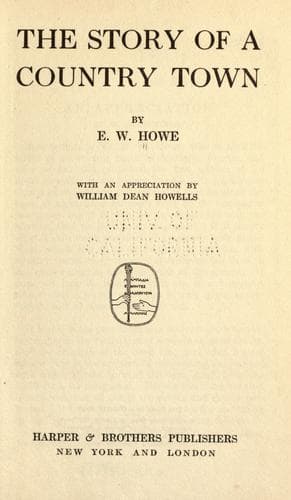
The Story of a Country TownHowe, E. W. (Edgar Watson)
General
The Story of a Country Town
Howe, E. W. (Edgar Watson)
Frontier and pioneer life -- Kansas -- Fiction
“Well, I received an answer to it a day or two after coming here,
accompanied by an invitation to visit her, and I don’t mind confessing
to you that I went, as I had learned a great deal since I called there
the first time with your mother, and was anxious she should know it. In
fact, I have been there three times in three weeks. It’s only a short
distance to their house from here, and Barker gave me so many lessons in
bowing and politeness that I couldn’t resist the temptation to try
them.”
“And how did they work?”
“Oh, I forgot everything as soon as I got into the house, of course,” he
answered wearily, as though he were dreadfully slow in learning to be
polite. “She came up to me, and stood so close that I hadn’t room to
bow. When her mother came in, she shook hands, and I couldn’t have bowed
to her without pushing over my chair. It was a total failure, though I
am improving. I take off my hat now before going in at the gate. I am
under contract to go there to-morrow night, and you shall accompany me.
I have a new suit of clothes, too. They arrived a few days after I came
here; I asked Barker who sent them, and he said he supposed it must have
been God.
“Jo,” I said, “you are very happy here, I can see it already.”
“I confess that I am,” he replied; “more contented than I ever expected
to be anywhere. I am useful to Barker (so he is kind enough to say, at
least), and he told me to-day that he intends to pay me wages from the
time I came, instead of compelling me to work a long while for nothing.
Yes, I am very happy here; you have guessed my secret.”
I was heartily glad of it, and said so, and added that no one deserved
it more.
“But after all there is nothing like a fairy story in it; nothing
unreal, and nothing that is likely to melt away, and leave me a drudge
at Fairview again. I am simply in a place where, if I work hard, I shall
get something for it. Every one ought to have that opportunity,
therefore it is not too much to hope that my good fortune may continue.
I should have been as comfortably situated as I am now a good many years
ago (no one is so unworthy that he does not deserve pay for what work he
does well), but I have learned nothing, and earned nothing, until now,
though I am almost a man grown.”
Jo had been a full hand on the farm for several years, but he never
received anything for it, except complaints, and I understood what he
meant.
Public-domain text, read in full here on John Shaqi.
Reviews
Reviews
No reviews yet
Be the first to share your thoughts on this work.
Elsewhere in the archive
Join the Discussion
Join the discussion
Sign in to leave a comment or review.
Sign InorCreate an account