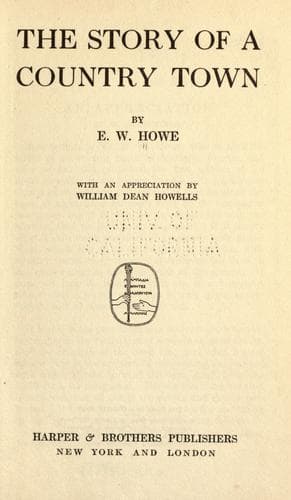
The Story of a Country TownHowe, E. W. (Edgar Watson)
General
The Story of a Country Town
Howe, E. W. (Edgar Watson)
Frontier and pioneer life -- Kansas -- Fiction
“But it is a most serious subject after all. If a man makes a mistake in
any other matter it is easily remedied; a day’s work, and he is as well
as ever, but a mistake in love is not so easily mended. It may make life
a failure, and cause a man to rest uneasily in his grave. If I should
leave a wife at death, and she should marry again, my very clay would
cry out in agony at the thought. Under such circumstances I should long
to be an unhappy ghost, that I might be free to walk the earth and fill
her nights with terror. I hope I am not naturally of an ugly
disposition, but if this misfortune should happen to me, I would resign
my place in heaven and join the devils, in order that I might be wicked
and cruel in my revenge.”
I had never seen Jo in such a serious mood before, and mentioned it. His
old, cheerful smile returned for a moment as he made some good-natured
response, but as he kept on thinking it was soon replaced with a frown.
Mateel seemed to enjoy his mood, and encouraged it by saying that a man
had a different opinion of love every year of his life.
“I never had an opinion on the subject at all until this year,” was his
reply, “but I will tell you what I think of it next year, and the next.
If I am of the same opinion then as now, you can give me the credit that
my first impressions represented me. My first impressions of the subject
are that I would as soon marry a widow as a girl who had been in love
before. If I were the king of a country I would punish second marriage
with death, and make it unlawful for a man or woman to be engaged more
than once, thus preventing the marital unhappiness which I am sure
always results when either the wife or husband knows the other has been
in love before.”
Mateel laughed so heartily over this absurd idea that I joined her in
spite of myself, though I knew Jo was very serious, and he looked at us
both as though we were attending his funeral and in good spirits over
the grave.
“I came here to pass a pleasant evening,” I said to him, “but if you
continue in this humor we shall all have the horrors presently.”
“I shouldn’t have begun,” he said, walking over to the music rack (to
look for a hornpipe, I thought), “but I have said no more than I really
feel. We will settle it with that, and I will never make you
uncomfortable again by referring to the subject.”
Having selected a more cheerful song we tried to sing it together, but
it was a failure, and the evening dragged heavily after that, so much so
that Jo announced his intention to go quite early.
“I was never gloomy in my life before,” he said to Mateel on parting. “I
don’t know what caused me to be to-night, for I am usually happier here
than anywhere else. It must have been the gloomy poet whose song you
sang. I hope you will forgive me. When I come again we will not speak of
love. I know so little of it that I can’t be entertaining talking about
it.”
Public-domain text, read in full here on John Shaqi.
Reviews
Reviews
No reviews yet
Be the first to share your thoughts on this work.
Elsewhere in the archive
Join the Discussion
Join the discussion
Sign in to leave a comment or review.
Sign InorCreate an account