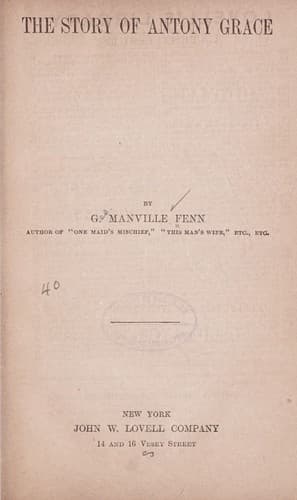
England -- Fiction; Orphans -- Fiction; Runaway children -- Fiction; Young men -- Fiction
"Silence, boy!" she cried, looking at me vindictively. "Do you think I
do not know all because I sit helpless here? You, too, have helped to
encourage him in his madness, when he might have been a professional man
by now. I know all, little as you think it, even how you, and this
woman, too, fought against me. That child might have been the wife of a
good man now, only that he was this wretched creature's lover."
"Mother," cried Linny passionately, "are you mad? How dare you say such
things!"
"That's well," she cried. "You turn against me now. My boy is dying:
you have killed him amongst you, and the same grave will hold us both."
"Mrs Hallett," said Miss Carr, in her low, sweet voice; and the flush
of pride that had come for a few moments into her face faded out,
leaving nothing but resignation there, as she crouched there upon her
knees by the invalid's chair, "you do not know me, or you would not
speak to me like this. Don't turn from me," she said, taking One of the
poor weak woman's trembling hands.
"Out of my sight, wretch!" she cried. "Your handsome face fascinated
him; your pride has killed him! and you have come to triumph in your
work."
"No, no, no," sobbed Miss Carr in a broken voice, "do not condemn me
unheard; I have come to tell him how I love him. Mother, dear mother,"
she cried, "be pitiful to me, and join your prayers to mine that he may
live."
Poor weak suffering Mrs Hallett's face changed; her lips quivered, her
menacing hands trembled, and with a low moaning wail she bent down,
clasping Miriam to her breast, sobbing aloud as she rocked herself to
and fro, while Miriam clung to her, caressing the thin worn face, and
drawing herself closer and closer in a tight embrace.
How long this lasted I cannot tell, but it was interrupted by the
entrance of the doctor, who came in very softly.
"He is in a very critical state," he said in answer to the inquiring
eyes of all. "Hush, my good woman, you must try and be firm," he said
parenthetically to Mary, who was trying hard to smother her sobs in her
apron. "A nurse ought to have no feelings--I mean no sympathies. As I
said," he continued, "our patient is in a very critical state, but he
has now sunk into a very restful sleep. There is an access of strength
in the pulse that, however, may only be due to excitement, but your
visit, ma'am," he continued to Miss Carr, "seems to have wrought a
change--mind," he added hastily, "I don't say for the better, but there
is a decided change. I will come in again in a couple of hours or so;
in the meantime, let some one sit by his bed ready to give him the
stimulant the instant he wakes, but sleep may now mean life."
The doctor went softly away, and as he closed the door, Miss Carr knelt
down once more by Mrs Hallett's chair, holding up her face, and the
poor invalid hung back for a moment, and then kissed her passionately.
Public-domain text, read in full here on John Shaqi.
Reviews
Reviews
No reviews yet
Be the first to share your thoughts on this work.
Elsewhere in the archive
Join the Discussion
Join the discussion
Sign in to leave a comment or review.
Sign InorCreate an account