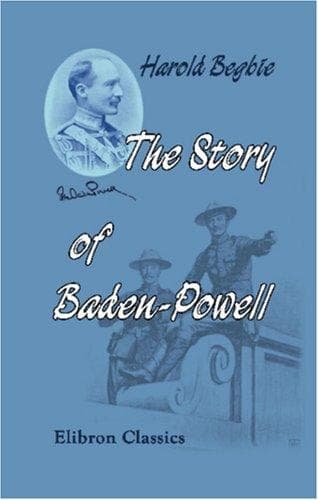
The Story of Baden-Powell: 'The Wolf That Never Sleeps'Begbie, Harold
History
The Story of Baden-Powell: 'The Wolf That Never Sleeps'
Begbie, Harold
Baden-Powell of Gilwell, Robert Stephenson Smyth Baden-Powell, Baron, 1857-1941
Baden-Powell's work when he arrived was almost entirely confined to
the office; and working at a desk from early morning to late at night,
with no prospect of an early closing movement, began to tell upon his
spirits. He became convinced that "our force is far too small
adequately to cope with so numerous and fairly well-armed an enemy,
with well-nigh impregnable strongholds to fall back on.... Our force,
bold as it is, is far too small, and yet we cannot increase it by a
man, for the simple reason that if we did we could not find the
wherewithal to feed it." If this sort of thing had gone on much longer
B.-P. might have learned to look glum for an entire five minutes; but
one night at ten o'clock, when he and Sir Frederick Carrington were
putting up the shutters of office, into the town rode Burnham, the
famous American scout, with news of a large impi of the enemy about
three miles outside Buluwayo. This necessitated action, and B.-P. was
himself again. With a police-trooper as a guide he rode out to find
for himself how matters stood, and, after a hard and refreshing ride,
in the early dawn he was able to see the enemy. There they were on the
opposite bank of the Umgusa river, their fires crackling merrily, and
they themselves apparently as happy as bean-feasters in Epping Forest.
Not long after he had caught sight of these fires and the Matabele
going backwards and forwards from the water, Baden-Powell was at the
head of two hundred and fifty men riding towards the Umgusa. Under the
impression, conveyed to them by their sorry old humbug of an oracle,
that the waters of the Umgusa would open its jaws and swallow up the
wicked white man, the Matebele allowed Baden-Powell to get his force
across the stream without firing a shot; but when they found that not
only did the waters fail to overwhelm their enemies, but that these
same enemies were riding hard towards them, the Matabele took to their
heels in order to find cover in some thicker bush. Then the air began
to scream and whistle. Bullets flew by the ears of the charging
English with a _phit, phit!_ and, when they ricocheted off the ground,
with a _wh-e-e-e-w!_ Up and down bobbed the black heads in the long
rank grass, and _bang, bang, bang_ went the guns. Some of
Baden-Powell's force wanted to dismount and return the fire, but
B.-P., without a sword among his men, sang out, "Make a cavalry fight
of it. Forward! Gallop!" Then, as the horses raced snorting forward,
and the English gave a shout of battle, the Matabele, 1200 against
250, poured an irregular volley into their enemies. The next minute
the horses were in among them, flashing by with the lather on their
necks, while their riders' revolvers barked angrily in every quarter
of the field. The Matabele ran. As hard as they could lick, they
bolted like rabbits to their holes, but faster behind them came the
avenging English with the velvet glove flung aside and the iron hand
visible to their terror-stricken eyes.
Public-domain text, read in full here on John Shaqi.
Reviews
Reviews
No reviews yet
Be the first to share your thoughts on this work.
Elsewhere in the archive
Join the Discussion
Join the discussion
Sign in to leave a comment or review.
Sign InorCreate an account