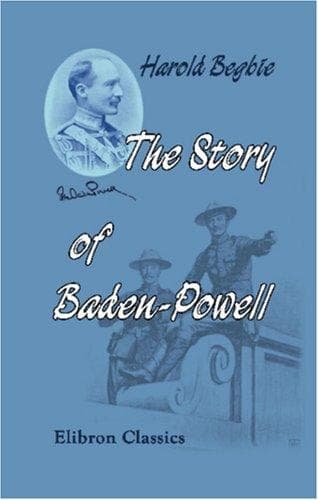
The Story of Baden-Powell: 'The Wolf That Never Sleeps'Begbie, Harold
History
The Story of Baden-Powell: 'The Wolf That Never Sleeps'
Begbie, Harold
Baden-Powell of Gilwell, Robert Stephenson Smyth Baden-Powell, Baron, 1857-1941
Baden-Powell's plans for the taking of this fort were perfectly
understood by his officers. The little force entrusted with the work
of carrying Game Tree moved out of the town in the dusk of early
morning, and in a few minutes the roar of artillery announced the
beginning of a desperate fight. The scream of the engine of the
armoured train told the men at the guns to cease firing, meaning that
Captain Vernon was ready to rush the position with the bayonet. The
scene that followed was magnificent. Waving their hats and cheering
like schoolboys after a football match, our men started to run through
the scrub towards the silent fort. And then as they went, a pitiless
fire suddenly poured in upon them, a hail of bullets tore up the
ground at their feet, swept down their gallant ranks, like grass
before the scythe, and the men realised amid that enclosing and
remorseless fire that treachery had forewarned the Boers, that Game
Tree was impregnable. But did they waver or turn back? Not them. They
were many yards from the fort, and their orders were to storm it. On
they rushed, the officers well in front, waving their swords in the
air and shouting cheerfully to their men to follow. Three officers,
Vernon, Sandford, and Paton, seem to have made a race of it. Through
that terrible zone of fire these young Englishmen rushed forward with
all the zeal of men striving to be first to touch the tape. Captain
Vernon fell ten yards from the thundering fort, and Sandford and Paton
were left to fight out that splendid race alone. With a shout from his
parched lips, Paton leaped upon the redoubt, caught with his strong
hand the corner of a sandbag, jerked it out of position, thrust his
revolver through the loophole, and, panting like a man spent, fired
into the enemy's midst till he fell, shot through his gallant heart.
Sandford, too, had run a great race, and had almost tied with Paton on
the post. He flung himself upon the piled wall that could only be
broken by heavy artillery, and fell shot through, with his breast
almost against the muzzles of the enemy's guns. Nor were the
non-commissioned officers and men far behind their valiant leaders;
one intrepid sergeant, who was twice wounded, and at some distance
from the redoubt, continued the race across the bullet-swept scrub and
reached the sandbags almost on the heels of Paton. The men went
forward shouting and cheering, unafraid to look death in the face,
afraid only to turn back with their faces from the sandbags where the
smoke drifted, and from whence the hail of bullets rained. There was
no coward among their ranks, and even when the gallant souls realised
that the position was impregnable, there was not a single man among
them who wavered, or dropped back in the race. From the moment when
the order to charge had been given, the attack was an eagerly
contested race, with Death sitting on the flaming fort with the crown
of glory for their prize.
Public-domain text, read in full here on John Shaqi.
Reviews
Reviews
No reviews yet
Be the first to share your thoughts on this work.
Elsewhere in the archive
Join the Discussion
Join the discussion
Sign in to leave a comment or review.
Sign InorCreate an account