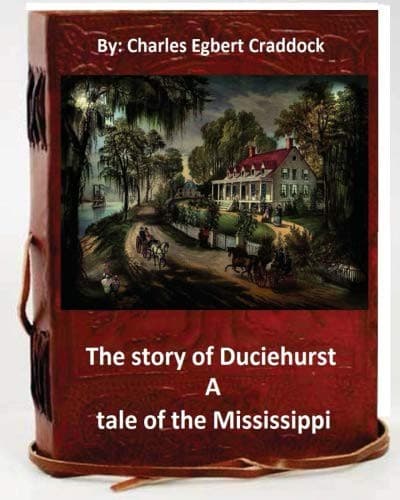
The Story of Duciehurst: A Tale of the MississippiCraddock, Charles Egbert
General
The Story of Duciehurst: A Tale of the Mississippi
Craddock, Charles Egbert
Mississippi River -- Fiction
Floyd-Rosney did not concur in this view. He had expected all the early
hours that some of the neighboring negroes would come to the house,
attracted by the rumors of the commotions enacted there during the
night. Thus he could hire a messenger to take a note or a telephone
message to the nearest livery establishment and secure a conveyance for
himself and family to the railroad station some ten miles distant. He
feared that hours, nay a day or so, might elapse before one of the
regular packets plying the river might be expected to pass. Those
already in transit had, doubtless, “tied up” during the storm, and now
waited till the current should compass the clearance of the débris of
the hurricane floating down the river. The steamers advertised to leave
on their regular dates had not cast off, in all probability, but lay
supine in their allotted berths till the effects of the storm should be
past, and thus would not be due here for twelve or twenty-four hours,
according to the distance of their point of departure.
As, however, time went on and the old house stood all solitary in the
gay morning light as it had in the sad moon-tide, Floyd-Rosney reflected
that no one had gone forth from the place except the robbers and the
roustabouts who had rowed the party down from the _Cherokee Rose_,
returning thither immediately. It was, therefore, improbable that any
rumor was rife of the temporary occupation of the Duciehurst mansion.
Hence the absence of curiosity seekers. Moreover, even were the
circumstances known, every human creature in the vicinity with the
capacity to stand on its feet and open and close its fingers was in the
cotton fields this day, for the sun’s rays had already sufficiently
dried off the plant, and the industry of cotton-picking, even more than
time and tide, waits for nobody. For “cotton is money,--maybe more,
maybe less, but cotton is money _every time_,” according to the old
saying. These snowy level fields were rich with coin of the republic.
The growing staple was visible wealth, scarcely needing the transmuting
touch of trade. No! of all the wights whom he might least expect to see
it was any cotton-picker, old or young, of the region.
Public-domain text, read in full here on John Shaqi.
Reviews
Reviews
No reviews yet
Be the first to share your thoughts on this work.
Elsewhere in the archive
Join the Discussion
Join the discussion
Sign in to leave a comment or review.
Sign InorCreate an account