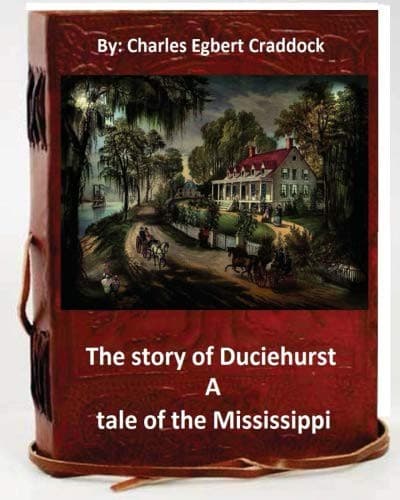
The Story of Duciehurst: A Tale of the MississippiCraddock, Charles Egbert
General
The Story of Duciehurst: A Tale of the Mississippi
Craddock, Charles Egbert
Mississippi River -- Fiction
Paula never understood the impulse that possessed her. Boldly, in the
presence of her husband, she took from her dainty mesh bag a small key
set with rubies and one large diamond.
“Your brother carelessly left one of the Ducie jewels on the table and I
picked it up. I am so glad I remembered to restore it to you. It should
have been in your possession long ago.”
Floyd-Rosney was watching her like a hawk, and she began to quail before
his eyes. Oh, why had she not remembered that he was a connoisseur in
bijouterie and bric-à-brac of many sorts and would detect instantly, at
a glance, the modern fashion and comparatively slight value of the
trinket. More than all, why had she not reckoned on the fact that Randal
Ducie was no actor. Who could fail to interpret the surprised
recognition in his eyes, his gentle upbraiding look before the
associations thus ruthlessly summoned? It was as if some magic had
materialized all the tender poignancy of first love, all his winged
hopes, all the heartbreak of a cruel disappointment crystallized in this
scintillating bauble in his hand. He glanced from it to her, then back
at the flashing stones, red as his heart’s blood. He looked so wounded,
so passive, as if content to succumb to a blow which he was too
generous, too magnanimous to return in kind.
And he said never a word.
She felt that her face was flaring scarlet; the hot tears were smitten
into her eyes. She could not speak, and, for a long moment neither of
the two men moved, although the horse, restive and eager to be off,
plunged now and again, almost lifting from his feet the groom at his
head, still swinging at the bit, but staring, as if resolved into eyes,
at the group on the piazza.
“It is the key to something of value”--she found her voice suddenly--“or
it would never have been so charmingly decorated. I hope it will unlock
all the doors shut against you,” she concluded with a little bow.
“Thank you,” he said formally. And he said no more.
“And now shall we go?” asked Floyd-Rosney curtly.
There being only four places, the gentlemen occupying the front seats,
Mrs. Floyd-Rosney, the nurse and the baby the others, there was no room
for the groom, and Ducie, gathering up the reins preparatory to driving,
directed him to return to the livery stable on one of the cotton wagons
which would be starting in an hour or so. The ill-looking fellow touched
his cap, loosed the bit and the horse sprang away with an action so
fine, so well sustained, that Floyd-Rosney’s brow cleared. The pleasure
of the moment was something.
“What will you take for him?” he asked, quite human for the nonce.
“Not for sale. Couldn’t spare him,” Ducie responded, the reins wound
about his forearms, all his strength requisite to hold the abounding
vitality and eagerness of the animal to the trot, the hoofs falling
with the precision of machinery, mile after mile.
Public-domain text, read in full here on John Shaqi.
Reviews
Reviews
No reviews yet
Be the first to share your thoughts on this work.
Elsewhere in the archive
Join the Discussion
Join the discussion
Sign in to leave a comment or review.
Sign InorCreate an account