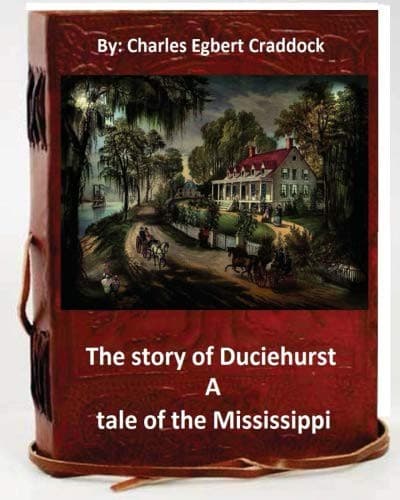
The Story of Duciehurst: A Tale of the MississippiCraddock, Charles Egbert
General
The Story of Duciehurst: A Tale of the Mississippi
Craddock, Charles Egbert
Mississippi River -- Fiction
Paula reached her destination early the next morning. She had not slept
during the night and as soon as the light began to dawn she raised the
blind at her window and lay in her berth looking out drearily at the
face of the country, growing constantly more familiar, but yet dimly
descried and colorless as a scene in sepia, with the lagging night still
clinging to the earth. Belts of white vapor lay in every depression; the
forests along the horizon made a dark circumference for the whole; the
stars were wan and sad of aspect and faded from the sky, one by one, as
the eye dwelt upon them. The characteristic features of the swamp region
had vanished. In many places the land was deeply gullied, showing as the
day waxed a richly tinted red clay that made the somber landscape glow.
Everywhere were the hedges of the evergreen Cherokee rose, defining the
borders of fields, often untrimmed and encroaching in a great green
billow on spaces unmeet for a mere boundary mark. The trees were huge;
gigantic oaks and the spreading black-gum; and she was ready, her hat
on, her wrap and furs adjusted, looking out eagerly at these dense bosky
growths when the red wintry sun began to cast long shafts of quiet dull
sheen adown their aisles, showing the white rime on the rough bark of
the boughs, or among the russet leaves, still persistently clinging.
More than once the conductor came in to consult her as to the precise
point of stoppage, and, when a long warning whistle set the echoes astir
in the quiet matutinal atmosphere and the train began to slow down, she
was alertly on her feet.
“You are sure of the place, ma’am?” said the conductor, helping her
descend the step; he was new to the road, and there seemed to him
nothing here but woods.
She reassured him as she lightly ran down the steep incline, and then
she stood for a moment, mechanically watching the train, epitome of the
world, sweeping away and leaving her here, the dense forest before her,
the smoke flaunting backward, the sun emblazoning its convolutions, the
wondering faces of the passengers at the windows.
She remembered the time when this wonder would have nettled her. She had
wanted a station platform built here, but her uncle had utilitarian
theories, and, somehow, “never got round to it,” as he was wont to
phrase it. So seldom, indeed, they boarded the train, so seldom it
brought a visitor, that it seemed to him the least and last needed
appurtenance of the plantation. She wondered if the stoppage had been
not noted at the house. The woods were silent, as with mystery, as she
took her way through “the grove.” The frost lay white on the grass, and
there was even a glint of ice in the water lurking in the ruts of a
wagon wheel in the road. She walked on these frozen edges after a
fashion learned long ago to keep her feet dainty when not so expensively
shod as now. Suddenly she heard the deep baying of a hound.
“Oh, old Hero!” she exclaimed pettishly. “He will tell them all I have
come!”
Public-domain text, read in full here on John Shaqi.
Reviews
Reviews
No reviews yet
Be the first to share your thoughts on this work.
Elsewhere in the archive
Join the Discussion
Join the discussion
Sign in to leave a comment or review.
Sign InorCreate an account