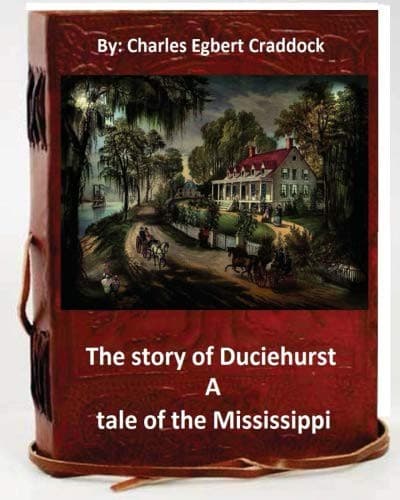
The Story of Duciehurst: A Tale of the MississippiCraddock, Charles Egbert
General
The Story of Duciehurst: A Tale of the Mississippi
Craddock, Charles Egbert
Mississippi River -- Fiction
Mrs. Majoribanks was a stern-faced woman with rigid ideas of the
acceptable in conduct. Her dark hair, definitely streaked with gray,
banded smoothly along her high forehead, her serious, compelling, gray
eyes, the extreme neatness and accuracy of adjustment of her dress, her
precise method of enunciation, intimated an uncompromising personality,
possessing high ideals religiously followed,--somewhat narrow of view,
perhaps, and severe of judgment, but unfalteringly, immovably upright.
“But, Paula, why didn’t you buy your own ticket with your own money? To
allow another to buy it was inappropriate.”
“I had no money,” Paula explained humbly. “Mr. Floyd-Rosney lets me buy
anything I want on account, but he never gives me any money to spend as
I like.” Once more the husband and wife looked significantly at each
other. All that they possessed was his, but the privileges of ownership
were exercised in common, the expenditures a matter of mutual confidence
and agreement, and it may be doubted if he ever took a step in business
affairs without consultation with her.
The spare, sober decorum of the aspect of the house appealed to Paula in
her present state of mind, her taste for magnificence glutted, and she
remembered, with a sort of wonder, her intolerance of the stiff old
furniture of the sitting-room covered with hair-cloth; the crimson
brocade, well frayed, of the parlor glimpsed through the open door, with
the old-fashioned lambrequins at the windows and carefully mended lace
curtains, and the family portraits in oil on the walls; the linoleum on
the floor of the hall that had been there seeming indestructible since
she could remember; the barometer hanging over the long sofa; the
grandfather’s clock in the corner, still allotting the hours, however
lives might wax or wane; the dining-room, with the burly sideboard and
the peacock fly-brush, and the white-jacketed waiter, and the brisk
little darkey that ran in and out with the relays of hot buttered
waffles. It all seemed so sane, so simple, so safe. Here and there,
conspicuously placed, were gifts which she and Mr. Floyd-Rosney had
made, ostentatiously handsome. She thought them curiously out of accord
with the tone of the place, and, oddly enough, she felt ashamed of them.
She asked herself how and why had such an obsession as had possessed her
ever come to her--the hankering for the empty life of show, and fashion,
and wealth. Had she not had every reasonable wish gratified, enjoyed
every advantage of a solid and careful education, had every social
opportunity in a circle, limited, certainly, but characterized by
refinement, and dignity, and seemliness, that was the gentility of long
traditions of gentlefolks--not pretty manners, picked up the day before
yesterday. She had come back to it now--her wings clipped, her feathers
drooping.
Public-domain text, read in full here on John Shaqi.
Reviews
Reviews
No reviews yet
Be the first to share your thoughts on this work.
Elsewhere in the archive
Join the Discussion
Join the discussion
Sign in to leave a comment or review.
Sign InorCreate an account