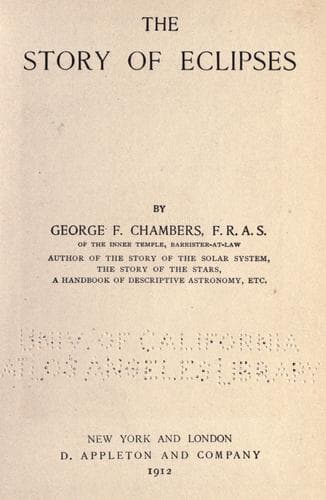
The Story of EclipsesChambers, George F. (George Frederick)
History
The Story of Eclipses
Chambers, George F. (George Frederick)
Eclipses
Eclipses of the Moon, though more often and more widely visible than
eclipses of the Sun, do not offer by any means the same variety of
interesting or striking phenomena to the mere star-gazer, and it was
long thought that they were in a certain sense of no use to science.
Now, however, astronomers are inclined to utilise them for determining
the diameter of the Moon by noting occultations[116] of stars by the
Moon, the duration of a star’s invisibility behind an eclipsed Moon
being a measure of the lunar diameter when such an observation is
properly transformed and “reduced.” Observations of the heat radiated
(or rather reflected) by an eclipsed Moon have also been made with the
interesting result of showing that during an eclipse the Moon’s power to
reflect solar heat to the Earth sensibly declines.
The duration of an eclipse of the Moon is dependent on its magnitude.
Where the eclipse is total the darkness, or what counts for such, may
last for nearly 4 hours, though this is an extreme limit rarely
attained. An eclipse of from 6 to 12 digits (to use the old-fashioned
nomenclature which has been already explained) will continue from 2½ to
3½ hours. An eclipse of 3 to 6 digits will last 2 or 3 hours, and a
smaller eclipse only 1 or 2 hours. The visual observations to be made in
connection with partial or total eclipses of the Moon chiefly relate to
the appearances presented by our satellite when immersed in the Earth’s
shadow. On such occasions, as has been already stated, it frequently
happens that the Moon does not wholly disappear, but may be detected
either with a telescope or even without one. It may exhibit either a
dull grey appearance, or more commonly a pinkish-red hue to which the
designation “coppery” is generally applied. Perhaps the most remarkable
instance of this was the eclipse of March 19, 1848.
Mr. Forster who observed the phenomenon at Bruges thus describes[117]
what he saw:—“I wish to call your attention to the fact which I have
clearly ascertained, that during the whole of the late eclipse of March
19 the shaded surface presented a luminosity quite unusual, probably
about three times the intensity of the mean illumination of the eclipsed
lunar disc. The light was of a deep red colour. During the totality of
the eclipse the light and dark places on the face of the Moon could be
almost as well made out as on an ordinary dull moonlight night, and the
deep red colour where the sky was clearer was very remarkable from the
contrasted whiteness of the stars. My observations were made with
different telescopes, but all presented the same appearance, and the
remarkable luminosity struck everyone. The British Consul at Ghent, _who
did not know there was an eclipse_, wrote to me for an explanation of
the blood-red colour[118] of the Moon at 9 o’clock.”
Public-domain text, read in full here on John Shaqi.
Reviews
Reviews
No reviews yet
Be the first to share your thoughts on this work.
Elsewhere in the archive
Join the Discussion
Join the discussion
Sign in to leave a comment or review.
Sign InorCreate an account