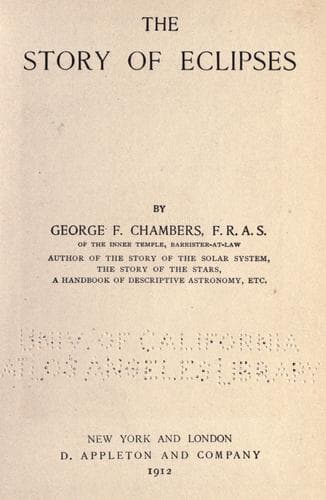
The Story of EclipsesChambers, George F. (George Frederick)
History
The Story of Eclipses
Chambers, George F. (George Frederick)
Eclipses
It has been suggested that if the portion of the Earth’s atmosphere
through which the Sun’s rays have to pass is tolerably free from aqueous
vapour, the red rays will be almost wholly absorbed, but not the blue
rays; and the resulting illumination will either only render the Moon’s
surface visible with a greyish blue tinge, or not visible at all. This
will yield the “black eclipse”—to recall the phrase quoted elsewhere.
If, on the other hand, the region of the Earth’s atmosphere through
which the Sun’s rays pass be highly saturated, it will be the blue rays
which suffer absorption, whilst the red rays will be transmitted and
will impart a ruddy hue to the Moon. Finally, if the Earth’s atmosphere
is in a different condition in different places, saturated in some parts
and not in others, a piebald sort of effect will be the result, and some
portions of the Moon’s disc will be invisible, whilst others will be
more or less illuminated. Further illustrations of all these three
alternatives will be found amongst the eclipses of the Moon recorded in
the chapter[121] devoted to historical matters.
A few instances are on record of a curious spectacle connected with
eclipses of the Moon which must have a word of mention. I refer to the
simultaneous visibility of the Sun and the Moon above the horizon, the
Moon at the time being eclipsed. At the first blush of the thing this
would seem to be an impossibility, remembering that it is a cardinal
principle of eclipses, both of the Sun and of the Moon, that the three
bodies must be in the same straight line in order to constitute an
eclipse. The anomalous spectacle just referred to is simply the result
of the refraction exercised by the Earth’s atmosphere. The setting Sun
which has actually set has apparently not done so, but is displaced
upwards by refraction. On the other hand, the rising Moon which has not
actually risen is displaced upwards by refraction and so becomes, as it
were, prematurely visible. In other words, refraction retards the
apparent setting of one body, the Sun, and accelerates the apparent
rising of the other body, the Moon. The effect of these two
displacements will be to bring the two bodies closer by more than 1° of
a great circle than they really are, this being the conjoint amount of
the double displacements due to refraction.
Public-domain text, read in full here on John Shaqi.
Reviews
Reviews
No reviews yet
Be the first to share your thoughts on this work.
Elsewhere in the archive
Join the Discussion
Join the discussion
Sign in to leave a comment or review.
Sign InorCreate an account