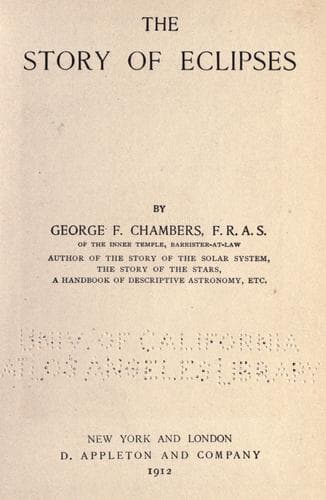
The Story of EclipsesChambers, George F. (George Frederick)
History
The Story of Eclipses
Chambers, George F. (George Frederick)
Eclipses
An eclipse of the Moon took place in the 4th year of the 91st Olympiad,
answering to August 27, 413 B.C., which produced very disastrous
consequences to an Athenian army, owing to the ignorance and incapacity
of Nicias, the commander. The army was in Sicily, confronted by a
Syracusan army, and having failed, more or less, and sickness having
broken out, it was decided that the Athenians should embark and quit the
island. Plutarch, in his _Life of Nicias_, says:—“Everything accordingly
was prepared for embarkation, and the enemy paid no attention to these
movements, because they did not expect them. But in the night there
happened an eclipse of the Moon, at which Nicias and all the rest were
struck with a great panic, either through ignorance or superstition. As
for an eclipse of the Sun, which happens at the Conjunction, even the
common people had some idea of its being caused by the interposition of
the Moon; but they could not easily form a conception, by the
interposition of what body the Moon, when at the full, should suddenly
lose her light, and assume such a variety of colours. They looked upon
it therefore as a strange and preternatural phenomenon, a sign by which
the gods announced some great calamity.” And the calamity came to pass,
but only indirectly was it caused by the Moon!
Plutarch and Pliny both mention that eleven days before the victory of
Alexander over Darius, at Arbela in Assyria, there was an eclipse of the
Moon. Plutarch’s words (_Life of Alexander_) are, that “there happened
an eclipse of the Moon, about the beginning of the festival of the great
mysteries at Athens. The eleventh night after that eclipse, the two
armies being in view of each other, Darius kept his men under arms, and
took a general review of his troops by torch-light.” This seems to have
led to a great deal of disorderly tumult in the Assyrian camp, a fact
which was noticed by Alexander. Several of his friends urged him to make
a night attack on the enemy’s camp, but he preferred that his
Macedonians should have a good night’s rest, and it was then that he
uttered the celebrated answer, “I will not steal a victory.” Plutarch
enters upon some rather interesting moral reflections connected with
this answer, but which of course are foreign to the subject of this
volume. This eclipse happened on September 20, 331 B.C., and was total,
the middle of the eclipse being at about 8.15 p.m. It follows therefore,
that the celebrated battle of Arbela was fought on October 1, 331 B.C.
In 219 B.C. an eclipse of the Moon was seen in Mysia, according to
Polybius.[123] The date of September 1 has been assigned for this
eclipse which is said to have so greatly alarmed some Gaulish Mercenary
troops in the service of Attalus, King of Pergamos, that he had to get
rid of them as soon as he could—make terms with them to go home.
Public-domain text, read in full here on John Shaqi.
Reviews
Reviews
No reviews yet
Be the first to share your thoughts on this work.
Elsewhere in the archive
Join the Discussion
Join the discussion
Sign in to leave a comment or review.
Sign InorCreate an account