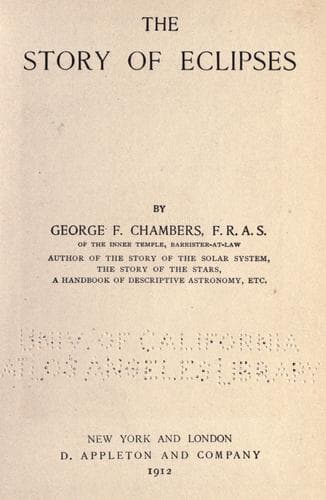
The Story of EclipsesChambers, George F. (George Frederick)
History
The Story of Eclipses
Chambers, George F. (George Frederick)
Eclipses
“The Indians refused to minister to their wants any longer; and famine
was imminent. But just at this last extremity, the admiral, ever fertile
in devices, bethought him of an expedient for re-establishing his
influence over the Indians. His astronomical knowledge told him that on
a certain night an eclipse of the Moon would take place. One would think
that people living in the open air must be accustomed to see such
eclipses sufficiently often not to be particularly astonished at them.
But Columbus judged—and as the event proved, judged rightly—that by
predicting the eclipse he would gain a reputation as a prophet, and
command the respect and the obedience due to a person invested with
supernatural powers. He assembled the caciques of the neighbouring
tribes. Then, by means of an interpreter, he reproached them with
refusing to continue to supply provisions to the Spaniards. ‘The God who
protects me,’ he said, ‘will punish you. You know what has happened to
those of my followers who have rebelled against me; and the dangers
which they encountered in their attempt to cross Haiti, while those who
went at my command made the passage without difficulty. Soon, too, shall
the divine vengeance fall on you; this very night shall the Moon change
her colour and lose her light, in testimony of the evils which shall be
sent upon you from the skies.’
“The night was fine: the moon shone down in full brilliancy. But at the
appointed time the predicted phenomenon took place, and the wild howls
of the savages proclaimed their abject terror. They came in a body to
Columbus and implored his intercession. They promised to let him want
for nothing if only he would avert this judgment. As an earnest of their
sincerity they collected hastily a quantity of food and offered it at
his feet. At first, diplomatically hesitating, Columbus presently
affected to be softened by their entreaties. He consented to intercede
for them; and, retiring to his cabin, performed, as they supposed, some
mystic rite which should deliver them from the threatened punishment.
Soon the terrible shadow passed away from the face of the moon, and the
gratitude of the savages was as deep as their previous terror. But being
blended with much awe, it was not so evanescent as gratitude often is;
and henceforth there was no failure in the regular supply of provisions
to the castaways.”
Tycho Brahe observed a lunar eclipse on July 7, 1590. He writes:—“In the
morning about 3¾h. the Moon began to be eclipsed: in this eclipse it is
notable that both luminaries were at the same time above the horizon; a
like case which Pliny cites. For the centre of the Sun emerged when the
Moon was 2° elevated above the Western horizon, and when her centre was
setting, the centre of the Sun was elevated nearly 2°.”[135]
Public-domain text, read in full here on John Shaqi.
Reviews
Reviews
No reviews yet
Be the first to share your thoughts on this work.
Elsewhere in the archive
Join the Discussion
Join the discussion
Sign in to leave a comment or review.
Sign InorCreate an account