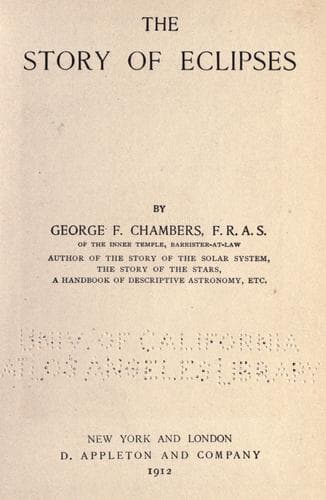
The Story of EclipsesChambers, George F. (George Frederick)
History
The Story of Eclipses
Chambers, George F. (George Frederick)
Eclipses
An obelisk was the simplest, though an imperfect form of Heliotropion,
marking indistinctly the length of a shadow at different times of the
year, especially the extremes of length and shortness at mid-winter and
mid-summer. It is perhaps interesting to mention that travellers have
recorded, in various places, various devices for furnishing information
respecting these matters. For instance, in Milan Cathedral the meridian
line is marked on the pavement, and along this line, an image of the Sun
coming through an aperture in the southern wall travels backwards and
forwards during the year according to the seasons. Some Jesuit
missionaries who visited China about the middle of the last century,
noticed a device of this character in operation at the Observatory at
Pekin. A gnomon had been set up in a low room and one of the
missionaries, M. Le Comte, describes in the following words what they
saw in connection with this gnomon:—“The aperture through which the rays
of the Sun came was about 8 ft. above the floor; it is horizontal and
formed of two pieces of copper, which may be turned so as to be farther
from, or closer to, each other to enlarge or contract the aperture.
Lower was a table with a brass plate in the middle on which was traced a
meridian line 15 ft. long, divided by transverse lines which are neither
finished nor exact. All round the table there are small channels to
receive the water, whereby it is to be levelled.”[32]
All this may seem rather a digression, and so it is, but I am following
Mr. Bosanquet herein in order the better to justify the argument that
it was an eclipse of the Sun which marked the important incident in
Hezekiah’s life which has been handed down to us by the sacred writer.
It is evident that if a flight of steps were erected on the principles
which were set forth above, the steps sloping upwards and southwards
(for the Northern Hemisphere) from the lowest step to within a few
inches below an aperture in the gnomon suitably arranged, the ray or
image of the Sun, whichever it was, would travel day by day up and down
such steps between solstice and solstice. We may conclude, therefore,
that the instrument which Hezekiah gazed at, and which is called in
Scripture, the “Dial” of Ahaz, was what the Greeks would have termed a
Heliotropion.
Public-domain text, read in full here on John Shaqi.
Reviews
Reviews
No reviews yet
Be the first to share your thoughts on this work.
Elsewhere in the archive
Join the Discussion
Join the discussion
Sign in to leave a comment or review.
Sign InorCreate an account