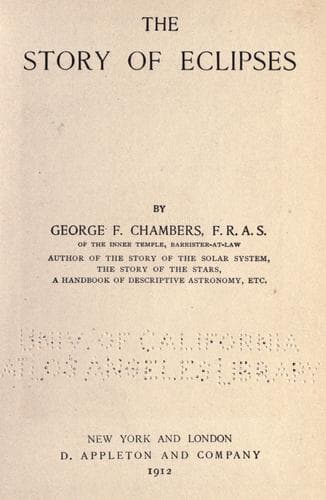
The Story of EclipsesChambers, George F. (George Frederick)
History
The Story of Eclipses
Chambers, George F. (George Frederick)
Eclipses
The historian’s record is to the effect that on the day of Hezekiah’s
recovery an extraordinary motion of the shadow was observed on the
“Steps of Ahaz” by the rising of the shadow “ten steps” from the point
to which it had “gone down with the Sun.” This effect is spoken of not
as a miracle but as “a sign.” It should also be remembered that the cure
of Hezekiah was effected not by a miracle but by a simple application of
a lump of figs. The promise of his recovery was confirmed by the motion
of the shadow as already stated. We are justified, therefore, in looking
for some ordinary natural phenomenon by which to account for this
peculiar motion on the dial, and something miraculous is not essential.
Dean Milman once suggested that the effect might have been produced “by
a cloud refracting the light.” No doubt a dark cloud might produce an
apparent interference with the shadow, but it is well pointed out by
Bosanquet that such a cause as a cloud would have been so manifest to
everyone, and the effect so transient, that the phenomenon could hardly
have been referred to afterwards as it was in another place as “a wonder
that was done in the land.” (2 Chron. xxxii. 31).
It becomes, therefore, alike an obvious and a simple explanation that a
shadow caused by the Sun might be deflected downwards on such an
instrument with a regular and steady motion by the Moon passing slowly
over the upper part of the Sun’s disc, as Sun and Moon both approached
the meridian.
The critical question has now to be raised: “Can astronomers inform us
whether a considerable eclipse of the Sun occurred at the beginning of
the year 689 B.C. anywhere near noon and which was visible at
Jerusalem?” And the answer to this it is interesting to be able to say
is a plain and distinct affirmative. There was a large partial eclipse
of the Sun on January 11, 689 B.C., about 11.30 A.M., and it was the
upper limb which underwent eclipse.
This eclipse fulfils all the requirements of the case, both from the
historian’s and the astronomer’s point of view. It occurred about the
year fixed by Demetrius as that of Hezekiah’s illness: it occurred while
the Sun was approaching and actually passing the meridian; the
obscuration was on that part of the Sun’s disc (namely the upper part)
which would have had the effect of causing the point of light, which
would seem to emanate from the Sun, to appear to be depressed downwards;
and it was visible at Jerusalem. But there still remains for
consideration the final and most important question, “Would a deflection
of light proceeding from the Sun, regarded as a moving body, be capable
of affecting, to the extent of ‘ten steps,’ the shadow on such an
instrument as has been described?” And arising out of this, there is the
subordinate question, “Would January, being the month when this eclipse
certainly occurred, also be a month suitable for the exhibition of such
a phenomenon?”
Public-domain text, read in full here on John Shaqi.
Reviews
Reviews
No reviews yet
Be the first to share your thoughts on this work.
Elsewhere in the archive
Join the Discussion
Join the discussion
Sign in to leave a comment or review.
Sign InorCreate an account