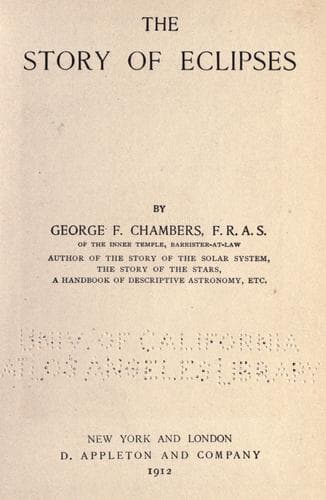
The Story of EclipsesChambers, George F. (George Frederick)
History
The Story of Eclipses
Chambers, George F. (George Frederick)
Eclipses
The total eclipse of July 28, 1851, may be said to have been the first
which was the subject of an “Eclipse Expedition,” a phrase which of late
years has become exceedingly familiar. The total phase was visible in
Norway and Sweden, and great numbers of astronomers from all parts of
Europe flocked to those countries. Amongst those who went from England
were Sir G. B. Airy, the Astronomer Royal (then Mr. Airy), Mr. J. R.
Hind and Mr. Lassell. The Red Flames were very much in evidence, and the
fact that they belonged to the Sun and not to the Moon was clearly
established. Hind mentions that “the aspect of Nature during the total
eclipse was grand beyond description.” This feature is dwelt upon with
more than usual emphasis in many of the published accounts. I have never
seen it suggested that the mountainous character of the country may have
had something to do with it, but that idea would seem not improbable.
In the year 1858, two central eclipses of the Sun occurred, both
presenting some features of interest. That of March 15 was annular, the
central line passing across England from Lyme Regis in Dorsetshire to
the Wash, traversing portions of Somersetshire, Wiltshire, Berkshire,
Oxfordshire, Northamptonshire, Lincolnshire, and Norfolk. The weather
generally was unfavourable and the annular phase was only observed at a
few places, but important meteorological observations were made and
yielded results, as regards the diminution of temperature, which were
very definite. All over the country rooks and pigeons were seen
returning home during the greatest obscuration; starlings in many places
took flight; at Oxford a thrush commenced its evening song; at Ventnor a
fish in an aquarium, ordinarily visible in the evening only, was in full
activity about the time of greatest gloom; and generally, it was noted
that the birds stopped singing and flew low from bush to bush. The
darkness, though nowhere intense, was everywhere very appreciable and
decided. The second central eclipse of 1858 took place on September 7
and was observed in Peru by Lieutenant Gilliss of the U.S. Navy. The
totality only lasted one minute, and the general features of a total
eclipse do not appear to have been very conspicuously visible. Gilliss
remarks[110]:—“Two citizens of Olmos stood within a few feet of me,
watching in silence, and with anxious countenances, the rapid and
fearful decrease of light. They were wholly ignorant that any sudden
effect would follow the total obscuration of the Sun. At that instant
one exclaimed in terror “_La Gloria_,” and both, I believe, fell to
their knees, filled with awe. They appreciated the resemblance of the
Corona to the halos with which the old masters have encircled their
ideals of the heads of our Saviour and the Madonna, and devoutly
regarded this as a manifestation of the Divine Presence.”
Public-domain text, read in full here on John Shaqi.
Reviews
Reviews
No reviews yet
Be the first to share your thoughts on this work.
Elsewhere in the archive
Join the Discussion
Join the discussion
Sign in to leave a comment or review.
Sign InorCreate an account